Showing posts with label seasonal chores. Show all posts

Tuesday, June 07, 2016

Garden goal roll 2016

My garden goal roll is more than just a "To Do" list.  Yes, this checklist is very definitely the way that I remember what needs doing when, but it also serves as my electronic diary, where I can record what worked and what didn't.  Sometimes that thing that didn't work is me: my personal rate of success in meeting my tasks is about 40%.  Thankfully, Mother Nature performs to a higher standard.

Rhododendon "Lodestar"

April

Dust peonies with copper fungicide to limit blight. Done 3/31/2016.  Re-apply in June.

Top-dress spring-flowering bulbs with 3-5-3 when the leaf-tips emerge.  Done 3/27/2016.

Prune and clean up shrubs damaged by winter snows.

Shape "New Dawn" rose canes. Done 5/15/2015. And figure out a support structure.

Weed and move lambs ear to new back bed.

Feed evergreens along front of house with Holly-Tone.

Dose "New Dawn" rose with 1/2 cup of Epsom salts in 2 cups water.

Trim "Major Wheeler" honeysuckle back.

May

Plant dahlias. Three Rose Toscano tubers planted at back bed against house on 6/5/2016.  Three Kelsey Radiance and one Kelsey Kristie dahlias planted in old side bed on 6/5/2016.  Two Uptown Girl tubers planted together at back bed against house on 6/12/2016. One Lights Out tuber planted in old side bed on 6/12/2016.

That stuff that you didn't get to last month?  Do it now.

Top-dress beds with composted cow manure throughout month.

Review spring bulb performance.  What needs to be replaced or amplified? Need +/- 20 tall purple alliums for back bed against house and +/- 200 miniature fuchsia alliums for beds along front walk.

June

Move potted amaryllis bulbs outdoors and feed regularly with liquid fertilizer.

Broadcast 5-10-5 fertilizer over flower beds and toss Holly-Tone on pachysandra and front foundation plantings on 6/12/2016.

Edge garden beds.

Prune into shape front foundation plantings and yews along side property line. Yews will be pruned by neighbor's landscaper. Privet hedge along property line cut back hard to 1' on 6/4/2016.
 
Scratch 1 1/4 cups of RoseTone around the roots of "New Dawn" climbing rose now monthly through the summer; be sure to stop feeding by August 15 in order to prevent developing new growth that will not have time to harden off before fall temperatures drop. First feeding 6/5/2016.

After flowering, shear Amsonia hubrichtii by 1/3 of its height to promote better form. Done.
 
When it is 3 feet tall, cut Joe pye weed "Gateway" back to half its height to encourage dense growth. Done 6/5/2016.

Stake dahlias when the tubers are planted and again and again as they grow. Stop dahlias by pinching stem back to four pairs of leaves. 
 
Pinch back shasta daisies to 6". Or just get rid of them?

And stake, stake, stake!

July

After flowering, prune the "New Dawn" climbing rose. 

Prune back 50-80% of "Major Wheeler" honeysuckle after bloom is over.

Late August/Early September

Separate Siberian irises to left of kitchen door (Eric the Red). Done August 27.

Time to order spring bulbs! 
*   Indoor at least 25 paperwhite narcissus bulbs and 2 amaryllis bulbs
*   Outdoor: See above!

Columbus Day

Plant spring bulbs. Done October 23: 25 "Gladiator" alliums in back bed against house and 100 fuchsia oreophilum alliums and 10 "Katherine Hodgkin" miniature irises along front walk.
 
Dig in bone meal around peonies.

Lightly feed evergreens along front of house with Holly-Tone.

Move potted amaryllis bulbs indoors and chill in refrigerator. Abandoned this effort.

Start forcing paperwhites indoors for Thanksgiving bloom.

Veterans Day

Top-dress beds with composted cow manure.

Late December

Start planning plant purchases for 2017.

Friday, April 01, 2016

Weeding weather

When spring starts to shift gears, the siren song of the garden becomes irresistible.  The temperature rises, the days lengthen, and dirt finds its way under one's fingernails. I think that the scent of turned earth--petrichor perfume--is just as hard-wired to happiness as the smell of baking bread, Chanel No. 5, or freshly-mown grass.

As soon as the soil warms, early spring is a great time to weed.  The plants that need to be removed can be easily pulled, and the ones that need to stay haven't yet ensnared weeds in their roots or secreted them in their foliage.

Sprouts from left to right, top to bottom: sedum, monarda, stachya, marsh marigold/moss/grass, dicentra, lovage, mystery, sedum, iris reticulata

This spring, I have two major weeding campaigns to conduct: (1) a recently added beebalm (Monarda "Pink Lace") has exposed its mint family breeding by aggressively and indiscriminately spreading the heck all over the place and, (2) over the years, numerous lambs' ears plants (Stachys byzantina) have quietly colonized older stands of Siberian irises. I have new homes staked out for these runaways.  As they say, a weed is just a plant in the wrong place, and I look forward to magically transforming these beebalm and lambs' ears plants from bad to good.

And then, there is just the garden-variety weeding: cleaning out mosses, grass, and ground ivy from the rain garden, edging beds, and yanking clumps of oxalis, purslane, and celandine. No redemption there.

Monday, May 19, 2014

Boundary issues

I have boundary issues. Not as in a lack of any boundaries--quite the opposite. I like boundaries. I like clearly marked property. I like name tags, monogrammed stationary, and signet rings. I like knowing what belongs to me and what doesn't. Don't even think about asking me to share my dessert.  It's not going to happen.

Garden boundaries not only mark off your bit of turf from your neighbor's, but they also organize all that green stuff into visually comprehensible blocks of lawn, bed, and hedge.

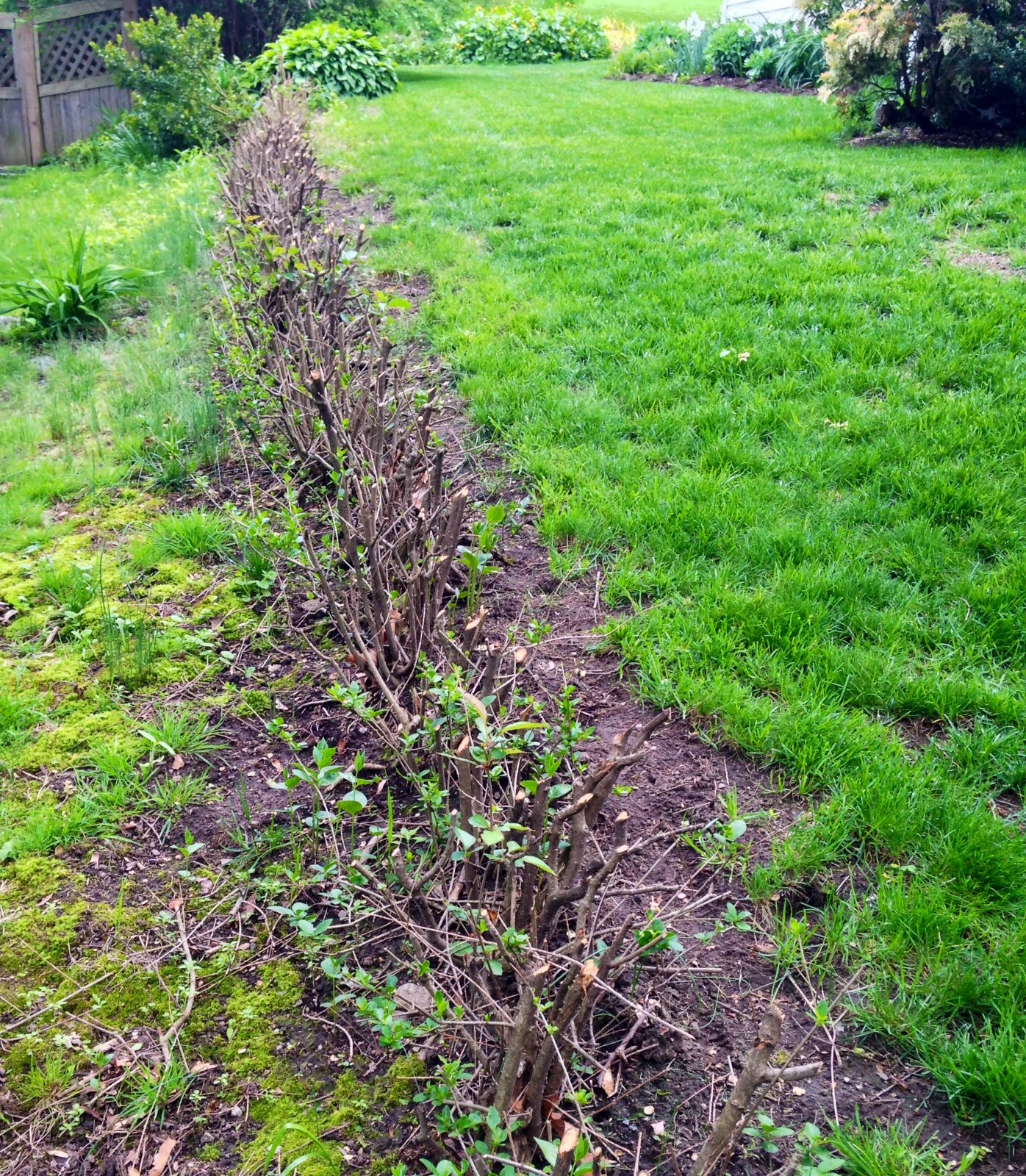
A line of privet separates one portion of the front yard from our neighbor's lot.  This hedge is homely, dead boring, and purely utilitarian, as all privet is.  Every few years the privet needs to be cut back hard in the spring in order to keep it from becoming tall and leggy.  Last weekend, it was snipped down to about a foot high.  Fertilizing, top-dressing, and edging are needed before it looks presentable.  Some new shoots and leaves would be helpful, too.

Pruned back privet

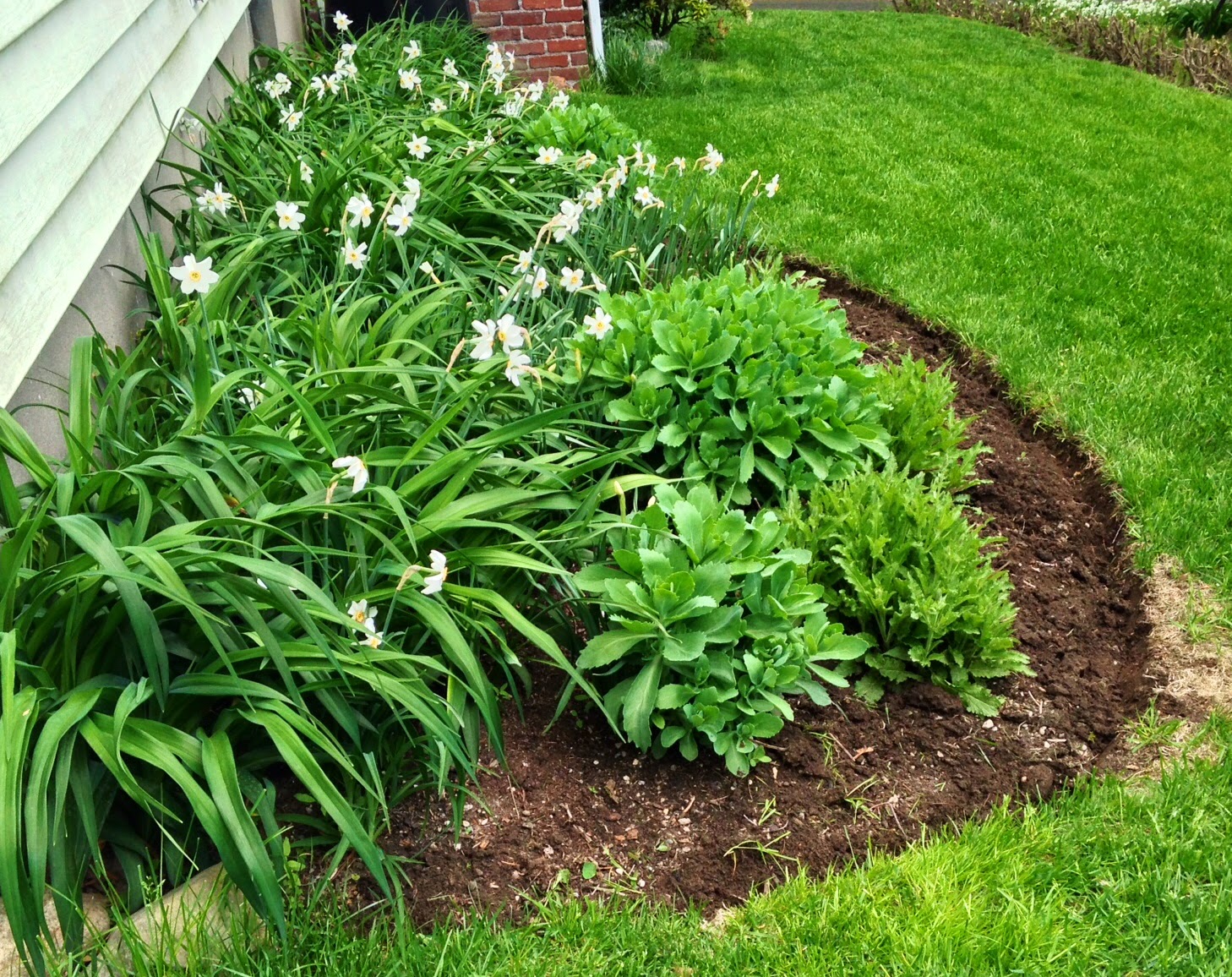
Yes, about edging. Using a half-moon edger, I try to border beds twice a year.  Nothing makes a garden look better tended (particularly if it is not) or eases the challenge of mowing along the border of a bed more successfully than a clean cut edge. And, visually, a bit of tidy edging brings into focus the break between a lawn's green even roll and the patterning of a flower bed.

Curving border along front walk
Received wisdom suggests that plants should sit anywhere from a few inches to a foot back from the edge of the bed.  I have found adherence to this rule to be a secret weapon in my mission to continually expand the size of the flower beds.  The plants grow larger so, hey, what can I do but cut a wider bed?  And, so, ugly patches of lawn are gobbled up.  In other words, not only will I refuse to share my dessert, but I'm likely to sneak a bite of yours!

Edging creep: the secret to silently expanding your flower beds
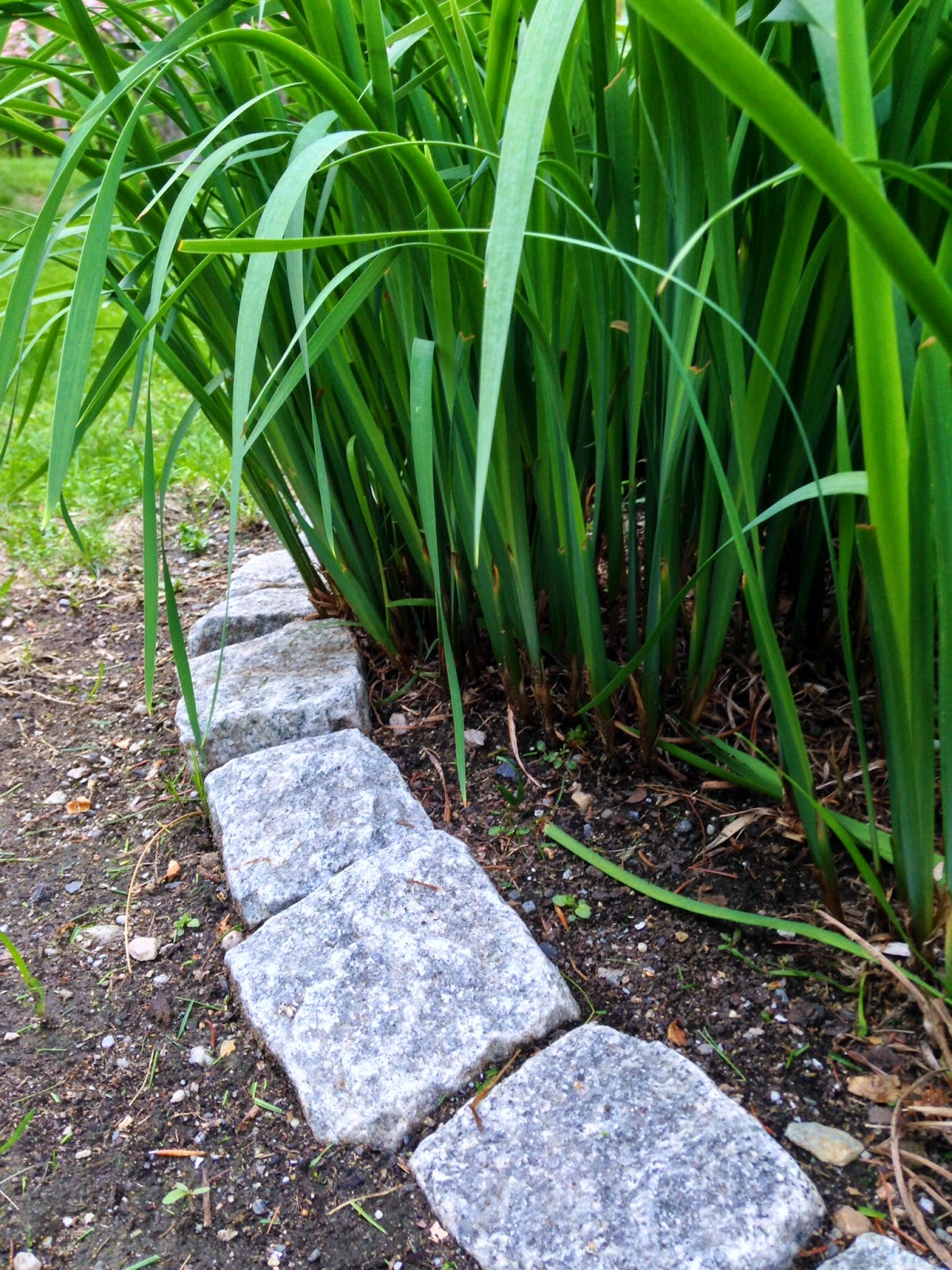
Sometimes a plain cut edge isn't enough, and the boundary needs to be marked more forcefully.  My parents used to call upon metal hoops and aluminum sheeting for this task--and I well remember the snarl of rusted junk to which those accoutrements inevitably decayed.  I've nevertheless considered resorting to sheet metal edging in order to stem the march of lilies of the valley from the back bed, but I'm not quite that desperate yet.  In the meantime, I limit myself to natural materials. Granite cobblestones, picked up at a local stone yard, add a line of contrasting color and texture to this bed of Siberian irises.

Granite cobblestone border
Good fences may make good neighbors, but they also make a person feel good herself. Dessert helps, too.

Tuesday, January 22, 2013

Mulching after the holidays

After the holidays, when the ground is solidly frozen, is the best time to apply winter mulch.  As a seasonal bonus, discarded Christmas tree boughs can be used as a terrific insulating layer. The idea here is to create a stable micro-environment around the roots of the plant in order to prevent the soil from heaving during freeze and thaw cycles.  Roots do not like to be pulled and pushed, ripped and torn!  The micro-environment under the mulch layer buffers against the effects of severe and sudden temperature changes, allowing the plant to ease along through the winter season.

Tops on my list for winter mulching is the "New Dawn" rose. After its run-in with Hurricane Sandy, it's been reduced to a stand of bare canes.

This rose will definitely be pruned and shaped come spring but in the meantime, the canes have been lassoed in between a ring of study metal garden stakes.

A pile of evergreen branches is heaped over the base of the rose.  When the weather starts to turn warm--in an eternity from now, I fear--the branches can be removed, a bit at a time. Over-wintering dahlias are similarly protected.

Best of all, this mulch is free and, for a brief period, widely available as folks haul their old trees to the curb for pick-up. Yes, you don't even need to make use of your own Christmas tree! Typically, we celebrate around a table-top tree--this year, a dwarf Alberta spruce--which can spare no branches.  So yes, I'm that person who's leaning over her neighbors' discarded trees with a pair of clippers in one hand and an armful of cut boughs in the other. It's all in the holiday sharing spirit, right?


Sunday, November 04, 2012

Transitions

Cleaning up hurricane damage this weekend started the transition towards winter.  The weather was cold and clear, the skies were sunny, and there was such a lot to do!


Cross off the seasonal chore list:

1. Cut "New Dawn" climbing rose to 6' tall young-middle aged canes and temporarily secure with stakes and twine; cut and bag the rest of the foliage for removal
2. Empty containers: harvest hot peppers, transplant herbs, and compost everything else
3. Plant 50 "Queen of the Pinks" Spanish hyacinth bulbs
4. Cut down peonies and clean away dead foliage; still need to apply bone meal
5. Pull up and discard faded annuals
6. Mow lawn: cut short and chop up fallen leaves

Only that little bit was accomplished? Geez . . . this transition needs to slow its speed . . . 

Friday, July 20, 2012

View from above

Some second floor pruning of the "New Dawn" climbing rose affords a few views from above. I think that I've got the Japanese garden design principle of borrowed scenery (shakkei) down, thanks to my neighbors' mad skills, and there's even a hint of the hill and pond (chisen-kaiyu-skiki) style, courtesy of the rain garden.


Of course, even from these lofty heights, what I mostly see is overdue deadheading, pruning that's calling out, and an urgent need for staking. 


Sunday, April 15, 2012

Springing dahlias?

It's mid-April. and I'm embarrassed to confess that only this weekend have I made my first spring foray into the garden.  The last few weeks have been busy with travel and family activities--I'm not complaining, mind you--so my time hasn't allowed digging around in the dirt.

This weekend was perfect gardening weather--breezy, sunny, and just warm enough to ease these old bones. Pruning, clipping, and weeding commenced.  In the weeks ahead, it will be all about compost spreading and fertilizing.  The days are light longer, so at last my after-work routine can incorporate some evening shovel time.

Anyway, as I was picking up the evergreen boughs that I'd spread over the dahlia tubers planted along the back of the house, I was amazed to see a row of tender green sprouts. I guess that I have my answer about outside over-wintering dahlias in Zone 6! Yes, it can most definitely be done. The tallest of these is about 6 inches.


I usually plant dahlia tubers on Memorial Day weekend--a good six weeks from now.  But as long as we don't have any final frosts and the rabbits don't develop a craving for these lovely green sprouts, this spring jump start could have dahlias blooming in June. Now if only I could catch up with my seasonal chores!

Tuesday, May 31, 2011

Memorial Day weekend: changing of the guard

Even if our local swimming pool isn't scheduled to open until July, Memorial Day weekend marks the end of spring and the beginning of summer, garden-wise, in this neighborhood.  It's time for changing of the guard.


On Duty:
Two new pots of "Sugary" grape tomatoes
Dahlias in both side beds and along the back of the house
Siberian irises from a work colleague
"New Dawn" roses fertilized with 1 1/4 cup of Rose Tone
Joe Pye weed (Eutrochium purpureum) "Gateway" cut down to 2 feet
Shasta daisies pinched back to 6 inches


Discharged:
Spent tulip bulbs
Weeds, lots of 'em
Marsh marigold seed heads
Lots of gardening energy


Thursday, November 20, 2008

Garden goalroll

A couple of months ago, my brilliant neighbor over at Skippy's Vegetable Garden posted an on-going list of garden ideas for next year. I figured that I could do with one, too.

Just as with those strategic planning exercises at work, I'm trying to think about SMART (Specific, Measureable, Attainable, Realistic, Time-sensitive) goals. I'll keep this list as a "Thinking ahead!" link on my sidebar and add new tasks--whoops, goals!--as inspiration strikes.

To keep this list alive, I've changed the order so that future tasks and their times are at the top and those of relevance--and, hopefully, completed--earlier in the season are towards the end.

May or June

When it is 3 feet tall, cut the joe pye weed "Gateway" back to half its height to encourage dense growth.

Fall

Move the summersweet Clethra ainfolia along the property fence so that they are placed between, rather than directly in front of, the "Sky Needle" hollies.

After the forsythia blooms

Move Amsonia hubrichtii towards front of bed for more sun.

Expand the new side bed to join more fluidly with the raingarden.

Add two Astilbe x rosea "Peach Blossom" to existing one.

Add two Chasmanthium latifolium Northern sea oats to existing one.

Consider replacing flagging forsythia with red osier dogwood Cornus sericea "Allemans." If only local nurseries would carry a decent inventory of shrubs!

Replace mallow in raingarden with Aster novae-angliae "Purple Dome."

Organize the bearded irises, so that visually compatible cultivars are grouped together. Tag individual plants so that they can be moved later in the season.

Explore new combinations of annuals, such as Ageratum houstonianum "Blue Danube" and Salvia farinacea "Victoria Blue," as inspired by the gardens at the Inn at Shelburne Farms. Sedum and iris foliage would complement. Ageratum houstonianum "Hawaii Blue" and Salvia farinacea "Victoria Blue" are going in from 05/17/2009

Resist the temptation to position dark dahlias in front of yews. Plant the following varieties: Rose Toscano (2 plants), Normandy Painted Pearl (1 plant), Rae Ann's Peach (1 plant) . . . Old side bed: "Karras 150" (white) and "Park Princess" (pink); new side bed: "American Dawn" (peach/pink/purple) and "Park Princess" (pink); house back: "Karma Choc" (dark red), "Rae Ann's Peach" (red/peach), and "Rose Toscano" (peach), all planted 05/16/2009

Plant three more Thymus serpyllum Coccineus plants along top of wall to left of front stairs.

When the forsythia blooms

Continue to prune front foundation plantings, especially rhododendron and little-leaf hollies.

Prune clethra to remove deadwood and shape.

Re-seed damaged portions of front lawn.


Monday, November 10, 2008

Zen and the art of garden maintenance

Closing down the garden in the fall is a time for contemplation. It's best to shift from puzzling over the inner workings of plant life--why didn't that grow here? will those come back in the spring?--and simply enjoy cutting down dead foliage, shoveling mulch, raking leaves--what an enlightened person might call being in the moment . . . and if you don't assume that mindset, you're likely to call chores.


Dead wood was pruned out from an old yew. My son's Japanese wood saw set the mood. I am planning to start a leaf pile in this back corner, so access needed to be improved. Also, this yew hadn't been cleared of dead wood for many years. And, the remaining green boughs should look nicer when the winter snows arrive.


This aged yew is fruiting more heavily than usual. I am hoping that this is not its last reproductive gasp, but a reinvigorated spirit. A fabulous local tree company is now providing a twice annual root drench of compost tea. A different type of tea than enjoyed by the Buddha, but perhaps part of its own Way.

Thursday, May 01, 2008

Merry May Day

Perfect conditions for gardening today: sunny, breezy, don't-break-a-sweat weather and all creation surging with greenery and growth. The old side bed was expanded--make way for dahlias--cleaned and edged. Still need to top-dress around the phlox, peonies, Siberian irises, and astilbe with composted cow manure.


And here's the most regal obstacle to dahlia planting. "Princess Irene" is enjoying a great bloom. She's not a very tall tulip, but that blend of orange and purple, especially against a background of maroon peony foliage, is commanding.


The coup d'etat will be delayed until the Princess' charms fade. Isn't that always the way?

Thursday, January 10, 2008

Looking to be lucky

The other day, I went to the local nursery to pick up a few stalks of "Lucky Bamboo" Dracaena sanderiana. Yes, it's only January, and that's how strung-out I was for the sight of some greenery.


Stuck in a water-filled bowl of pebbles, these shoots would almost have you believing that they actually bamboo . . . or at least a real plant. As long as I change their distilled water weekly and keep them out of direct sunlight, they carry on their charade admirably.

On the way out of the nursery clutching my bag of lucky bamboo shoots, I noticed that the ground was covered with leftover Christmas tree branches. Since we were on the road during the holiday season, there's no tree this year to harvest for winter mulch. I'm not adverse to clipping away at our neighbors' discarded trees on trash day, but this opportunity was so much more dignified. I filled the car trunk with pine boughs and happily drove home.

I like to wait until after Christmas to lay down mulch. The ground has to be frozen in order for the mulch to create a micro-climate that protects against the freeze-thaw cycle. And voles and mice will set up housekeeping in a cosy pile of mulch if the season's warm--without so much as a thank-you for the home delivery of tasty roots and stems. Unfortunately, during the few days between bringing home the branches and tucking them around, we've had our January thaw. The temperature has risen to the 50s, the snow is melting, and the air is balmy. Winter weather is forecast to return in a day or two.


So maybe I really will need some luck in order for this mulch to do its job. Good that I went for that bamboo after all.

Sunday, December 02, 2007

Winding down, winding up

The past week or so has been just bearably cold enough to allow a few end-of-season tasks:

Empty out containers: spent plants are retired to the compost pile; perennials like these succulents are dug into a corner of the garden. We'll see how well, if at all, they over-winter.


Rake maple leaves from the back beds. These will form a life-suppressing mat if left undisturbed. The frequent advice about leaving unraked leaves to serve as a winter mulch carries one large and generally omitted disclaimer: these mulches apply only to smaller, non-toxic leaves, like those from beech and dogwood trees.

Mow the lawn, short. Sadly, trimming newly sown grass is like giving a balding guy a haircut: he may have a new 'do, but he's still bald.


Prune back rose growth and tie canes to trellis.

Untap and store garden hoses.

Cut down perennials with wilted, diseased, or ugly foliage: peonies, phlox, irises, ladybells, hostas, astilbe.


Start drawing up my long list of spring chores.

Inside, a potted amaryllis is just starting to leaf out.


Time for a change of venue . . . and a cup of hot chocolate!

Sunday, November 04, 2007

Yellows

What better way to use today's extra "fall back" hour than in the garden? Perennials were cut down and several hundred more bulbs went into the ground. Although we haven't had a hard frost yet, the dahlias were spent.


No tuber trials this year: the plants directly went the way of yard waste. Nature abhoring a vacuum, allium and tulip bulbs were cycled into this spot. After they bloom next spring, they'll be replaced by another crop of dahlias.


Around here in early November, it's all about yellow foliage. When the flowers are gone and the leaves are dropping, these bursts of color fire up an otherwise insipid garden.

The brilliant amsonia in the foreground came as a slip from my prairie-gardening pal, DK. I stuck it into a back corner and, now, look at it a few years later. In addition to the steely-blue flowers in the spring and yellow fall foliage, its habit is graceful and delicate (kind of like the gift-giver herself, come to think of it!).


Astilbe foliage is beautiful all year, even as it dies.


Yellow leaves set against the dark stems of Clethra alnifolia "September Beauty" are a stunning addition to autumn. Why didn't I discover this genus years ago? And can I find room for more of these plants? That French drain did create some opportunities for new plantings . . . .

Sunday, October 28, 2007

BB-ID-LB L/W, etc.

Hitting the seasonal finish line just before the first frost, in comes my cryptic dahlia. So that's what "BB-ID-LB L/W" looks like.


While it may be charming up close and personal in a photograph, this dahlia is rather underwhelming in real life. And not just because the plant put out only one bud . . . which waited until the end of October to open. (Such a sorry performance may be the consequence of where it was stuck in the garden and not indicative of its true habit.) No, it's just that it's one of a number of lilac flowers that tie up this season: New England asters (Aster novae-angliae), hardy mums, Joe Pye weed (Eutrochium maculatum), etc. Aren't there enough of them already?

Today's cool clear weather was perfect for re-setting a cobblestone border and filling a bare bed with 80 grape hyacinths, 100 Tulip dasystemon, 100 Tulip "Apricot Impression," and 20 Tulip "Black Parrot." I dug a trench along the length of the bed, scrabbled in handfuls of Bulb-Tone, set in the bulbs, laid down 1' x 3' lengths of chicken wire, and then back-filled.


Much more to do, but with newly sown grass sprouting and most of the bulbs planted, this is a good place to be at the end of October.

Sunday, October 21, 2007

. . . to the ridiculous

Where to begin reconstruction of this barren landscape? Here's how the wasteland looked at the beginning of the weekend . . .


And here's how it looked at the close . . .


What's different? Anything? Nothing? Okay, this is going a lot slower than I had imagined.

My limited accomplishments:

1. Clumps of displaced lambs ear and Siberian iris were divided and re-planted.

2. The blue flag irises were re-planted. My wee wetlands have resisted the hydrological seduction of the new French drain. The water-filled footprints here promise more room in which to expand my knowledge of wetland plants.


3. Exactly 35 bulbs were planted. Only 745 left to go.


4. Some cobblestones were laid along the border of the bed. Additional stones are needed as a number went missing in action. For a former archaeologist, my lines are not very straight or level. I can live with that.

5. The would-be lawn was limed, fertilized, seeded and raked. Then I walked all over it, watched birds nip up seed from it, and hoped that rain might just visit it. Despite the current agitations of some anti-lawn types, I find that a stretch of green grass is essential to visually defining trees, bushes, and flowers. And I like to have a place to set up lawn furniture.


At least these guys are cheerful!

Tuesday, September 04, 2007

Laboring days

Perfect gardening weather and a long list of chores meant that much laboring was done over the Labor Day weekend.

Fall-blooming annuals (Argyranthemum frtescans "Vanilla Butterfly") were planted . . .


Clumps of old plants were divided into loads of new plants (here, an unnamed miniature hosta) . . .


Sun-loving plants (Coreopsis "Moonbeam") were moved out of the shade . . .


. . . and shade-loving plants (Anemone blanda "Honorine Jobert" ) were moved out of the sun.


Yes, I have not yet attained happiness in my relationship with these anemones. No amount of water and mulch could prevent the leaves from sun scorch so we're having a trial separation. They've packed their bags and moved to the digitalis and hosta neighborhood in a sheltered back side bed.

Also, the final three dwarf little-leaf hollies (Ilex crenata "Hellerii") were planted in the totally renovated foundation bed along the front of the house. But that's another post.

Monday, August 13, 2007

Saying "I do!"

Back from a lovely long weekend in the summer Eden of northern New Hampshire . . .


. . . to find the garden in dire need of late summer attention. The old stalks of larkspur were pulled, seed was collected, and in a moment of insanely wishful thinking comparable only to a bride telling herself, "I'll make him change once we're married," as she walks down the aisle, anemones were planted in their stead. Yes, the groom will stop doing whatever annoying thing it is that he does, and semi-shade, moisture-loving "Honorine Jobert" anemones will flourish in a dry southern exposure. Sea holly (Eryngium amethystinum) didn't even last a year in this location. Heart over head here: I just love anemones. Call me delusional. Then pass the watering can and mulch.


And how does the rest of the garden look? Rather underwhelming, given the dearth of flowers. What would we do without Phlox panticula? In this bed, the white blossoms of "David" blend rather nicely with the powdery mildew dusting the adjacent peony foliage. Sigh. Maybe this falls under the "unrealistic expectations" marriage myth.


However, one glorious sight: the brilliant white shafts of blossoms sported by the hosta "Guacamole."


As I worked, I had a little bunny buddy hanging out with me. Sometimes a silent partner is the best.

Sunday, July 22, 2007

So this is summer . . .

What's not to love about a glorious summer weekend? My pleasures are simple. This chaotic medley of sanvitalia "Sunbini," Cape daisy Osteospernum "Lemon Symphony," yarrow Achillea x "Summer Wine," and mealy-cup sage Salvia farinacea "Victoria Blue" makes me smile.


Up close, it's clear why these plants are so compatiable. The dark eye of the Cape daisy echoes the blue of the sage and the maroon of the yarrow. Although not visible in this detail, the tiny yellow flowers and reddish stems of the sanvitalia add more depth.


Other sources of happiness: the ever-changing kaleidoscopic show of daylilies . . .


. . . and the first dahlia of the season, "Matthew Juul." After my very unsuccessful attempt to over-winter dahlia tubers, I am a convert to just treating them like annuals. Yes, I am totally lacking moral fiber. Easy way? That's the path for me!


What glorious weather it was for working in the garden. Long over-due tasks can now be checked off the list: tie up and fertilize the dahlias, deadhead the shasta daisies, mulch the summersweet and forsythia bed, spread compost around the base of the Pieris japonica and dogwood, prune and fertilize the climbing rose, and weed, weed, weed!