Showing posts with label woodland garden. Show all posts

Monday, February 29, 2016

Deal sealed (or about Polygonatum odoratum var. pluriflorum "Varigatum")


Last summer, I wrote about scavenging a clump of Variegated Solomon's Seal from a construction site near work.  Once home, these bedraggled, tattered, debris-coated plants were tucked in a shady bed populated by hostas, sweet woodruff, and various shade-loving weeds.


This spring, the Solomon's Seals came up with bells on.  Well, at least they boasted small white pendant blossoms that look a bit like bells. The "odoratum" and "pluriflorum" portions of its Latin name are a tip to the sweet scent of its many flowers.


It's great when plantings that look this great cost absolutely nothing.  I'll try to remember that dash of kismet when I'm moaning over the sad remains of some costly specimen.  Because dead plants are  definitely part of the gardening deal.


Monday, July 28, 2014

Re-location, re-location, re-location!

Summer construction is underway across campus: parking lots are being torn up, buildings knocked down, and new foundations dug.  Yes, here we're partying like it's early 2008! In the midst of all of this activity, a few weeks ago I noticed a mournful clump of Variegated Solomon's Seal wedged between an asphalt roadbed and a chain-link fence. I asked folks working in the area if I could help myself to these orphans. "No problem" was the response. 
 
On site: Variegated Solomon's Seal (Polygonatum falcatum "Variegatum")  
 
Last week, I pulled up a half dozen stems of Solomon's Seal. The leaves were tattered, yellowed, and coated with construction debris.   
 
Leaves coated with construction debris
 
Although the rhizomes attached at the end of the stalks were firm and well-colored, the roots were desperately dessicated--they looked like old twine. So I stuck the rhizomes in a big bowl of water for a day, hoping to rehydrate all those parched parts.
 
Soaking the rhizomes

I'm not sure what effect, if any, that bath might have had, as the plants appeared the same after their spa treatment as they had before.  But at least they didn't look any worse.

Under water

I had been looking for some shade-loving plants to join a jumble of hostas under a spreading yew, so I knew just the bed for these Solomon Seals. After digging in forty pounds of composted cow manure, the rhizomes were planted to three inches depth and watered in.

Re-located
Right now they look pretty scrappy and not at all like the elegant cultivar they're touted to be.  I'm hoping that spring will bring a crop of fresh foliage and dangling flowers. Just imagine those white bordered leaves waving hello from this shadowy spot.

Sunday, July 15, 2012

Ferns: big deal, little deal, or no deal?

I'm not a big fan of ferns.  It's hard to understand how anyone can get too worked up over a plant whose major contribution seems to be . . .  what?  It's green.  It takes up space.  Big deal.


That said, I have found ferns helpful--in a "they also serve who only stand and wait" kind of way--in different areas of the garden.  Several marsh ferns (Thelypteris palustris) anchor  the damp and sunny end of the raingarden. Their foliage plays off the surrounding spiky iris leaves and decorative grasses.
 

A few Japanese painted ferns (Athyrium niponicum var. pictum) are nestled in the dry deep shade of an eastern red cedar. Note to self: since you actually paid good money for these ferns, move them out from the shadows and into a spot where they can actually be seen!


But most of the ferns found their own way into the garden.  There are plenty of these common ferns springing up along the edges of shady beds.  I'm not sure what variety they are.  Perhaps since we're in Massachusetts, they're Massachusetts ferns?


A ginormous clump of lady fern--currently bowled over flat on its back from the ravages of drought and heat--has settled itself in between two evergreens along the back property line.  Its red stems and spores are really quite beautiful.

Despite my low regard, I am always pleased to discover ferns growing in out of the way places--beneath hedges, down the backsides of slopes, in those neglected areas removed from sight and mind.  The other evening, I was weeding one of these damp and dreary marginal spaces--the kind of gnarly wasteland where ugly stuff happens and a lot of it--kind of like the vegetative version of the Mos Eisley Cantina in Star Wars. Among the weeds that don't seem to be able to grow anywhere else and the self-sowers that have escaped from their original locations, I was delighted to discover another fern variety--the sensitive fern (Onoclea sensibilis). 


This cache of four or five plants was growing in an area that is reliably damp and shady. Now that I've pushed some of the habitues of this low-rent district out, perhaps these ferns will be able to become a big deal in their own small way.

Monday, June 02, 2008

Weeds, never and forever

Pulling wayward lilies of the valley out of the lawn reminds me that a weed is commonly defined as any plant in the wrong location.

Some plants, though, I just can't consider to be weeds. Ever. The pristine blossoms of star-of-Bethlehem Ornithogalum umbellatum give it a free ride where ever it wants to go. Even smack dab in the middle of the lawn is perfectly okay.


Same goes for woodland phlox, jack-in-the-pulpit, and mayflower.


On the other hand, Japanese knotweed Polygonum cuspidatum is never welcome, any time or any place. After almost two years of battling this beast, I have practically eradicated all vestiges along the side property line. And, I am proud to say, without the assistance of herbicides--all natural, hand-pulled goodness. A few weak shoots poke up every few days, but nothing that can't be corrected by a gentle tug.


So I am happily too late to take advantage of these Japanese knotweed recipes offered by the New England Wild Flower Society

What is more primal than physically consuming your enemy? Bet these recipes taste delicious!

Monday, May 28, 2007

Memorial day

On this Memorial Day, I took a rest from my on-going battle against the Japanese knotweed invasion to remember some of the wonderful gardeners, past and present, whose horticultural gifts are flowering in my garden today.

First off, I have from my mother a multitude of lilies of the valley. These grew in an azalea bed next to her house in Maryland. For several years, she allowed me to take a big clump each spring. Now I have so many, they are popping up in my lawn.


Usually, they bloom in early May but this year they are a few weeks late. This woodland phlox (Phlox divaricata) hitched a ride with the lilies of the valley and has found a happy home at the front margin of the same bed.


These bluish mauve columbines were a gift from my work colleague and super New England coastal gardener, TRH, who received them from her father in the Midwest.


And from the same source comes the most hearty yellow iris.


My very horticulturally active sister-in-law kindly gave me a host of bi-colored irises. They bloom more lushly every year.


I am so grateful for all of these heirlooms!

Saturday, May 27, 2006

Chaos theory


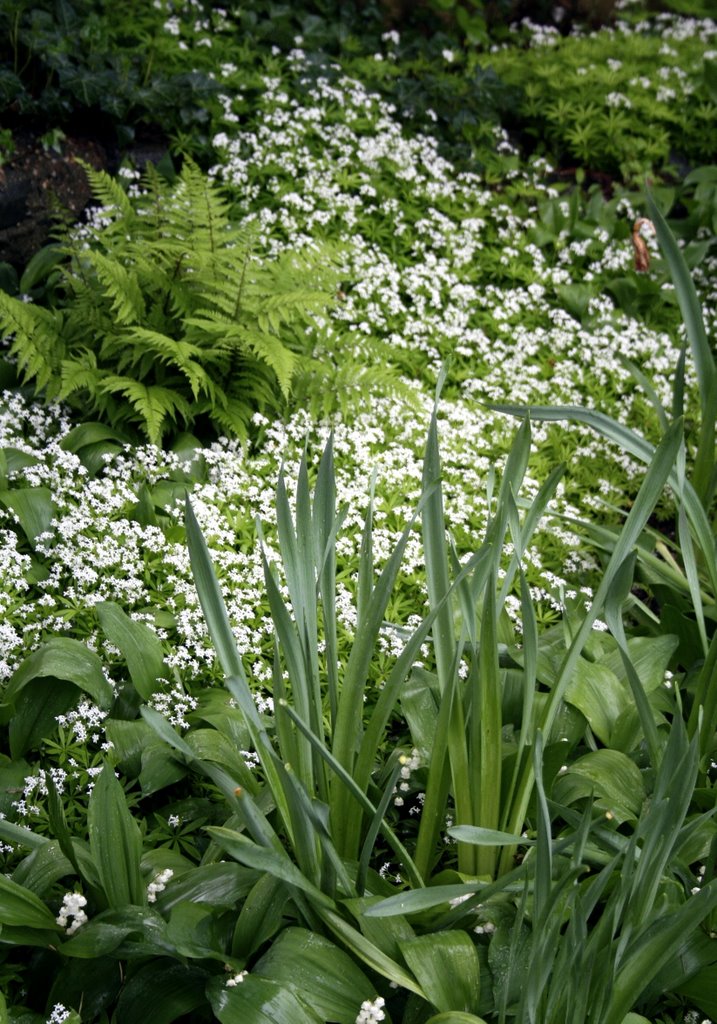
Along the back property line runs rampant a tumble of sweet woodruff, ferns, and lilies-of-the valley. Two weeks ago, the front of this bed was lit up with masses of "Mount Hood" daffodils. A row of tall evergreens wade through the chaotic greenery.

When I look at my neighbor's carefully spaced hostas surrounded by a sea of mulch, this bed makes me feel disoriented and somewhat dishevelled. But maybe I'm just dizzy from imagining what could be planted in that unused space over the hedge.