Showing posts with label new england gardens. Show all posts

Tuesday, April 10, 2012

Bookending visits to a sunken surprise

Last fall, I wrote about the happy discovery of a sunken garden on the grounds of the Radcliffe Institute.  Back then, the blooming season was creeping to a close, so I promised myself to pay another visit when the seasons had turned.  Once again, quite by chance, I found myself in the neighborhood earlier this week and decided to check in.

A few clusters of daffodils were spread along the banks of the walkways.  New growth--masses of Siberian and bearded irises--was just popping up.  One or two white tulips had launched, but the major volley was still in reserve. All the beds had already been mulched and signs of winter pruning were evident.  The garden is certainly tended with both talent and devotion.


Along one side, a row of white flowering bushes were in bloom. Again, I am bemoaning that no plant list is available.  What are these? Pearl bush (Exochorda sp.), perhaps?  They have an open, urn-shaped plant form and the petals are shorter and fewer than white-flowering magnolias (Magnolia x stellata)--which were just winding up their bloom season nearby. 


Maybe on a future visit, I'll be fortunate enough to run into the gardener.  In the meantime, I'm storing up my questions.

Friday, October 28, 2011

Sunken surprise

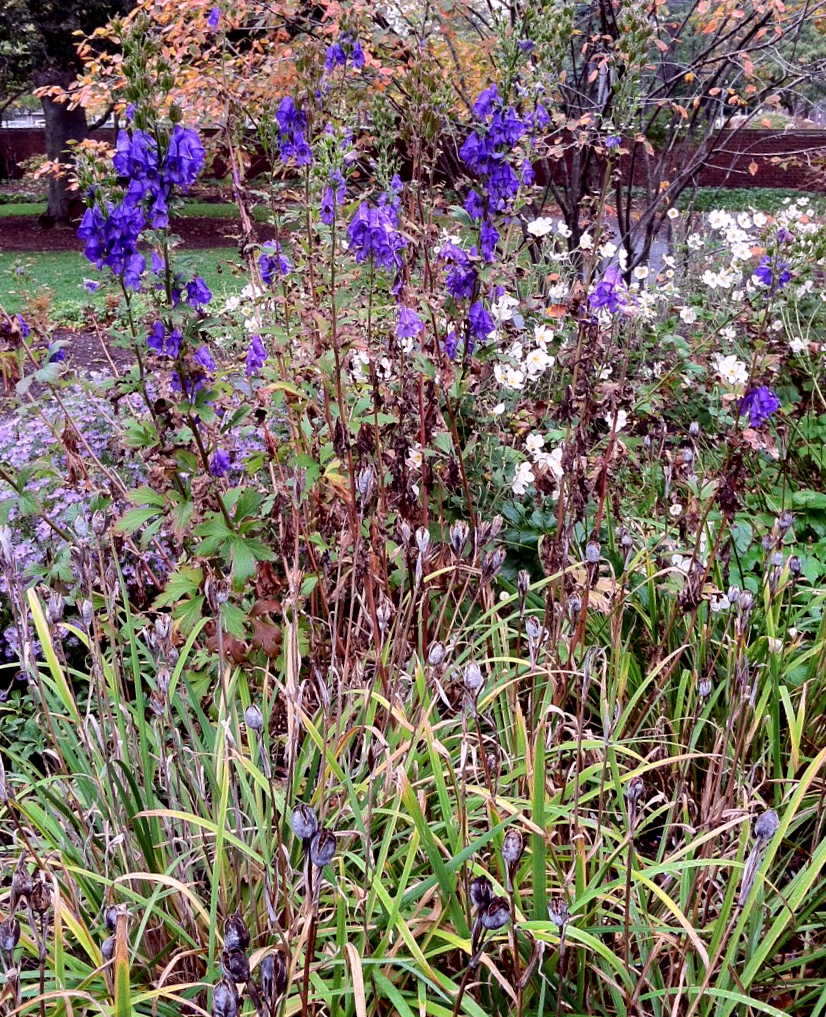
As I was racing to a luncheon lecture at the Radcliffe Institute earlier this week, I was stopped short in my steps by the sight of this lovely little sunken garden on the Institute's grounds. How could I have worked in Cambridge for a quarter of a century and never before stumbled upon this jewel?


It was decked out in fall flowers blue (asters, monkshoods, and irises--how is it that those are even flowering now?!) and white (anemones) and in foliage orange and green.


The hardscaping of stone and brick walks, walls, and water features provided a perfectly scaled framework.  The design led straight in the right places and swooped around in perfect curves.  Unfortunately, the fountain was also under renovation, preventing full access to the garden.  I can't wait to have a fuller visit this winter . . . and in the spring . . . and summer . . .


The only disappointment--and a surprising one, in light of its location in the most historically conscious and self-reflective university in this country--as well as one that sponsors a renowned landscape program--is that I could locate no information about when or by whom this sunken garden was designed.  A brief citation in a history of Radcliffe indicates that it was installed sometime in the first quarter of the 20th century.  Oh, and a plant list would be nice, too!


Tuesday, August 25, 2009

Chesterwood, Stockbridge

Hoping that I could beat the Boston heat, I slipped away for a brief jaunt to the marginally cooler climes of western Massachusetts. Among my carpe diem goals in life is to visit every one of the Gardens of the Berkshires. This weekend, the stop was in Stockbridge at Chesterwood, the home and studio of sculptor Daniel Chester French.

The grounds were pleasant enough but--how to say this?--under-gardened. A long bed sported lots of black-eyed Susans (Rudbeckia sp.) and monkshood (Aconitum sp.), along with some well-staked helenium. Serviceable, but not exactly the level of creativity that you'd expect to see in an artist's garden. There were lawns and woodland paths, too, but again . . .


An allee of flowering tree hydrangeas formed a promenade to the studio. Not exactly Giverny, but nice enough.


The most dramatic presentation of natural beauty that day was encountered elsewhere in Stockbridge: the thunder rolls and barrage of lightning bolts that accompanied a spectacular storm sweeping up the Hoosatonic River valley.

Sunday, November 02, 2008

From earth’s wide bounds

Halloween, All Saints Day, All Souls Day . . . . isn't this time of year when the veil between the living and the dead thins?

These seasonal reflections took me to Rock Meadow, one of my town's conservation areas. My colonial ancestors farmed a portion of this tract about 350 years ago. In walking over the mowed grass fields, I wondered how much this land has changed since the time that they pastured their livestock here.


These open fields? Local history indicates that this area was meadow, wetlands, and woods at the time of colonization.


Those clumps of Oriental bittersweet (Celastrus orbiculatus)? With its beguiling Halloween colors, this invasive plant is the devil in disguise. This herbaceous colonizer arrived around 1850.


A fascinating study of Henry David Thoreau's diaries, written during his sojourn at nearby Walden Pond, indicates how much the New England landscape has changed over the past 150 years. Since the 1850's, 27% of the plant species at Walden have disappeared; 36% are near extinction. Lilies, orchids, buttercups, anemones, asters, bluets, violets, roses, dogwoods, and mints have declined at the expense of mustards, knotweeds, and non-natives (hello, bittersweet). Global warming is not just about melting ice-caps and a few stranded polar bears--it hits us here and now.


Even on a winter afternoon at Walden Pond.

Friday, August 22, 2008

Will work for cheese

This past week, I vacationed on the Vermont shores of Lake Champlain. We stayed at the perfect place for any garden lover, the Inn at Shelburne Farms. This Gilded Age estate is sited on a bluff with the lake to one side and fields and forests rolling out to the other. The landscape, designed by Frederick Law Olmstead, is disorientingly beautiful, with wide sweeps of meadow swirling around islands of woodland. Rises and swales conceal and reveal views. See, I get a little loopy just talking about it. What's the horticultural version of Jerusalem syndrome?


In front of the Inn, a formal mixed garden is terraced down to the lake shore.


What is so wonderful about this garden is its simplicity: just an array of familiar flowers--ageratum, salvia, sedums, coneflower, phlox--perfectly tended and pleasingly positioned.


Even the stakes have a certain simple elegance.


On one level, a rose garden, bound by a brick wall with the lake beyond, is filled with hybrid teas and floribundas. If I hadn't been so overcome by the setting, I'm sure that I would have a better recollection. But that's no way to experience this garden.


In addition to the Inn, the Farms host an organic vegetable garden and a dairy that produces its own farmhouse cheddar. So now I know my dream job. If I could tend that lakeside garden, no salary is needed. Will work for cheese.

Sunday, February 17, 2008

Sweet serendipitous sightings

Serendipity is so sweet . . . and a delicious trip out to Tower Hill in Boylston, Massachusetts on a snowy afternoon was a feast for the senses.

The annual camellia show was in full bloom, on tree and afloat.


Nearby, the Orangerie was a garden of delights. Particularly wonderful was the way in which the colors of foliage--even the hues on the undersides of leaves--and flowers were combined with plant shapes. Shades of green, bronze, yellow, and purple echoed from plant to plant. Total eye candy.


In the cold and clear outdoors, witch hazels were just coming into flower. A beautifully pruned (as is every specimen there--it's the horticultural equivalent of hearing a crisply articulated speech or pitch-perfect aria) Hamamelis x intermedia "Pallida" was unfurling its yellow flowers.


Nearby, the red buds of witch hazel Hamamelis x intermedia "Diane" were breaking through their casings. That's the winter treat that I'll be planting this spring!

Thursday, August 30, 2007

Country cousins

An August trip to the Wellfleet Bay Wildlife Sanctuary on Cape Cod means visiting the country cousins of some cultivated friends. Beach rose (Rosa rugosa) and sea lavender (actually a statice, Limonium vulgare) populate the edges of the salt marsh.


Along the pond bank, wild summersweet (Clethra alnifolia) blooms in scented profusion.


Above is the native version of the four domesticated "September Beauties" that I planted around my yard this past spring. Below is the single panicle that my new plants are sporting between them. Very nice. The cluster of domesticated blooms is tight and showy. I can't compare the smell between wild and tame--in part because my sense of scent is weak--but up close and sniffing deeply, both smell heavenly.

Tuesday, June 19, 2007

Field trip to Tower Hill

Over the weekend, I took a break from tending my own garden to enjoy someone else's and to spend some time musing on matters horticultural and otherwise with my prairie-gardening pal, DK.


Tower Hill in Boylston, Massachusetts, was inspirational in its range. The curving beds of the cottage garden were filled with familiar plants like larkspur, sedums, and shasta daisies. In this setting, sweeping around a handsome specimen of witch hazel "Arnold Promise," these plants were unexpectedly dynamic.


In another area, plants were grouped systemically by scientific family. The didactic and aesthetic successes of this approach were generally, but not always, balanced. It may simply be impossible to make a border of pines interesting. However, here in the Saxifrage bed, the red stems of astilbe, maroon leaves of heuchera, and pink-flowering tiarella play off each other wonderfully. And how did they get those shade-loving plants to perform so robustly in the sun?


What else was there? Because of my on-going battle with its noxious cousin, an ornamental knotweed almost induced a fight-or-flee response. All I could see was a barbarian at the gate.


A more pleasant reaction was evoked by blue flag irises blooming along the edge of the pond.


In the woods was a Japanese milieu: stone lantern, ferns, and rhododendrons. Don't know whether the mosses covering these steps would be considered "Very Important" or merely "Interloper" in Japan.


After inspecting that exotic Arcadia, we emerged into the familiar New England landscape. Happy day!


Saturday, February 17, 2007

Winter respite

Snow and cold temperatures necessitated a visit this week to the warmer climes of the historic greenhouses at the Lyman Estate in Waltham.

My dear friend, DH, who left her own garden, two greenhouses, and allotment in London to enjoy New England in February, was knowledgable company.


Yes, the one hundred-year old camillias were wonderful . . . but the orchids were even more than wonderful. What variety of shape and color! There were dendrobiums, phalaenopses, cattleyas,

maroon-flowering cymbidiums,


brown cymbidiums,


yellow cymbidiums,


and my favorite, this deep salmon phragmipedium.


These are plants with which I need to become reacquainted. I had a dendrobium many years ago but was unaware that different orchids have different temperature, light, and water needs. Clueless. Time to find out what type of orchid will tolerate my windowsill. I think that I'll be back for the annual orchid sale at the Lyman Estate on March 23-25.