Showing posts with label lilies of the valley. Show all posts

Monday, May 19, 2014

Boundary issues

I have boundary issues. Not as in a lack of any boundaries--quite the opposite. I like boundaries. I like clearly marked property. I like name tags, monogrammed stationary, and signet rings. I like knowing what belongs to me and what doesn't. Don't even think about asking me to share my dessert.  It's not going to happen.

Garden boundaries not only mark off your bit of turf from your neighbor's, but they also organize all that green stuff into visually comprehensible blocks of lawn, bed, and hedge.

A line of privet separates one portion of the front yard from our neighbor's lot.  This hedge is homely, dead boring, and purely utilitarian, as all privet is.  Every few years the privet needs to be cut back hard in the spring in order to keep it from becoming tall and leggy.  Last weekend, it was snipped down to about a foot high.  Fertilizing, top-dressing, and edging are needed before it looks presentable.  Some new shoots and leaves would be helpful, too.
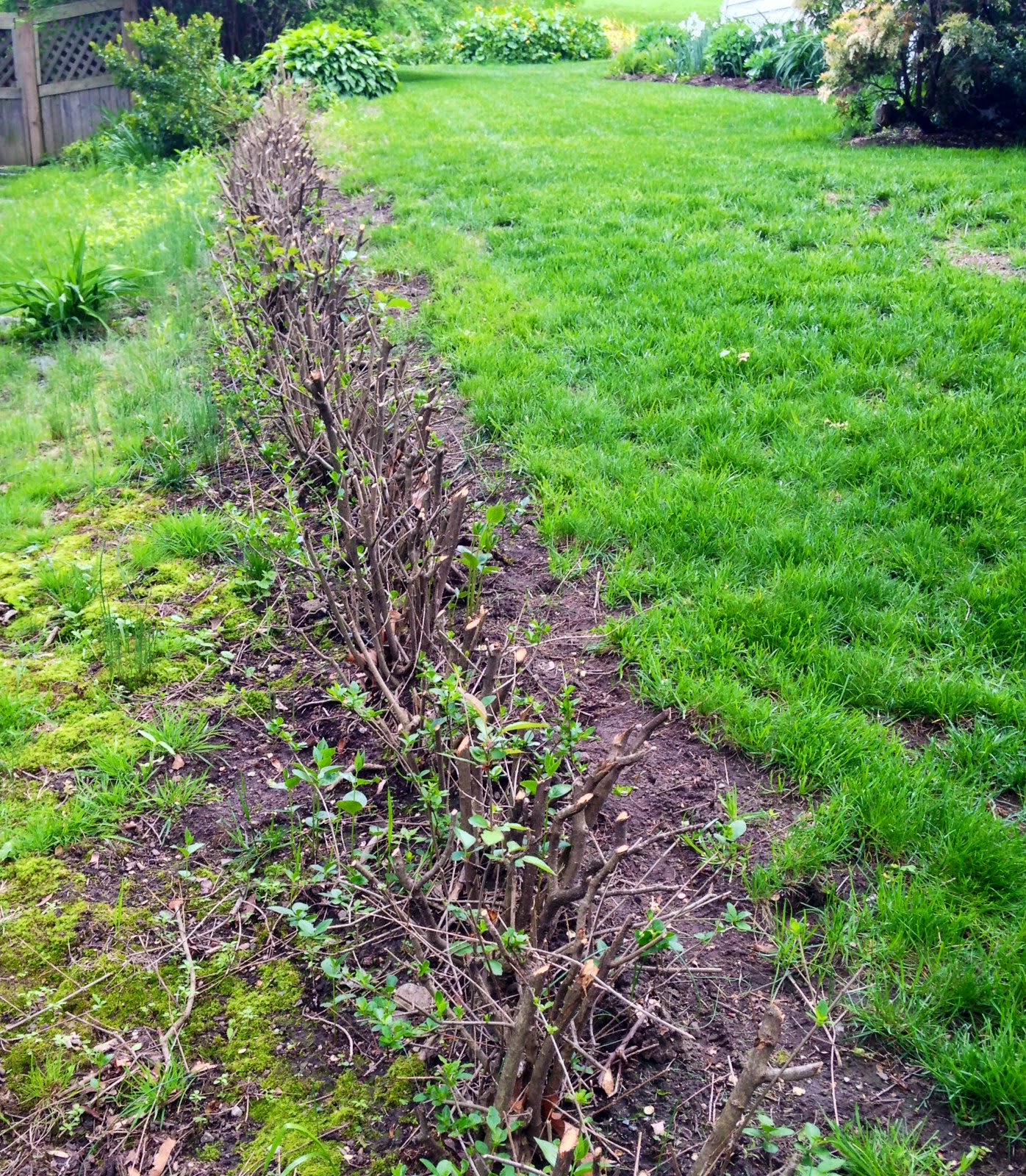
Pruned back privet

Yes, about edging. Using a half-moon edger, I try to border beds twice a year.  Nothing makes a garden look better tended (particularly if it is not) or eases the challenge of mowing along the border of a bed more successfully than a clean cut edge. And, visually, a bit of tidy edging brings into focus the break between a lawn's green even roll and the patterning of a flower bed.

Curving border along front walk
Received wisdom suggests that plants should sit anywhere from a few inches to a foot back from the edge of the bed.  I have found adherence to this rule to be a secret weapon in my mission to continually expand the size of the flower beds.  The plants grow larger so, hey, what can I do but cut a wider bed?  And, so, ugly patches of lawn are gobbled up.  In other words, not only will I refuse to share my dessert, but I'm likely to sneak a bite of yours!
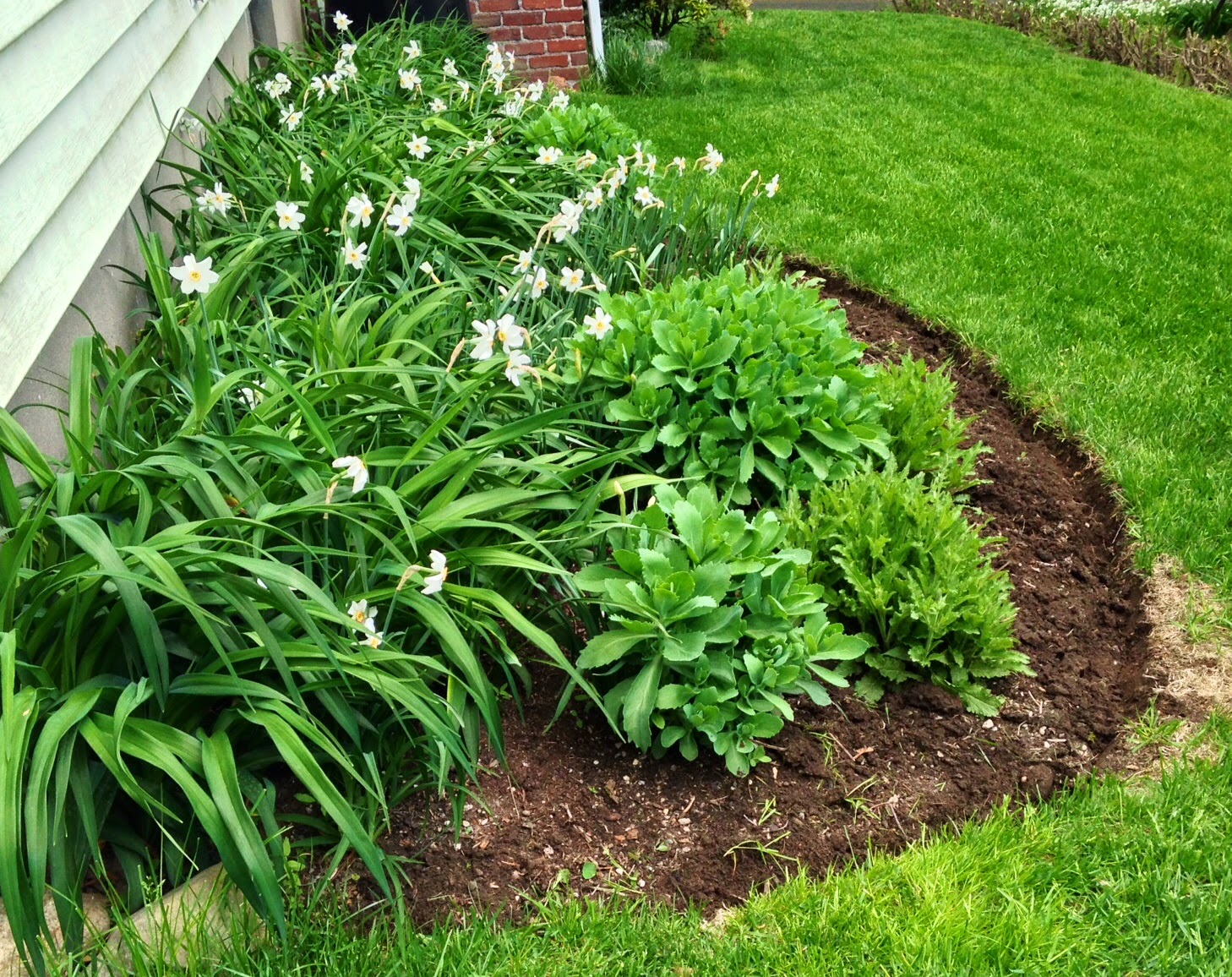
Edging creep: the secret to silently expanding your flower beds
Sometimes a plain cut edge isn't enough, and the boundary needs to be marked more forcefully.  My parents used to call upon metal hoops and aluminum sheeting for this task--and I well remember the snarl of rusted junk to which those accoutrements inevitably decayed.  I've nevertheless considered resorting to sheet metal edging in order to stem the march of lilies of the valley from the back bed, but I'm not quite that desperate yet.  In the meantime, I limit myself to natural materials. Granite cobblestones, picked up at a local stone yard, add a line of contrasting color and texture to this bed of Siberian irises.
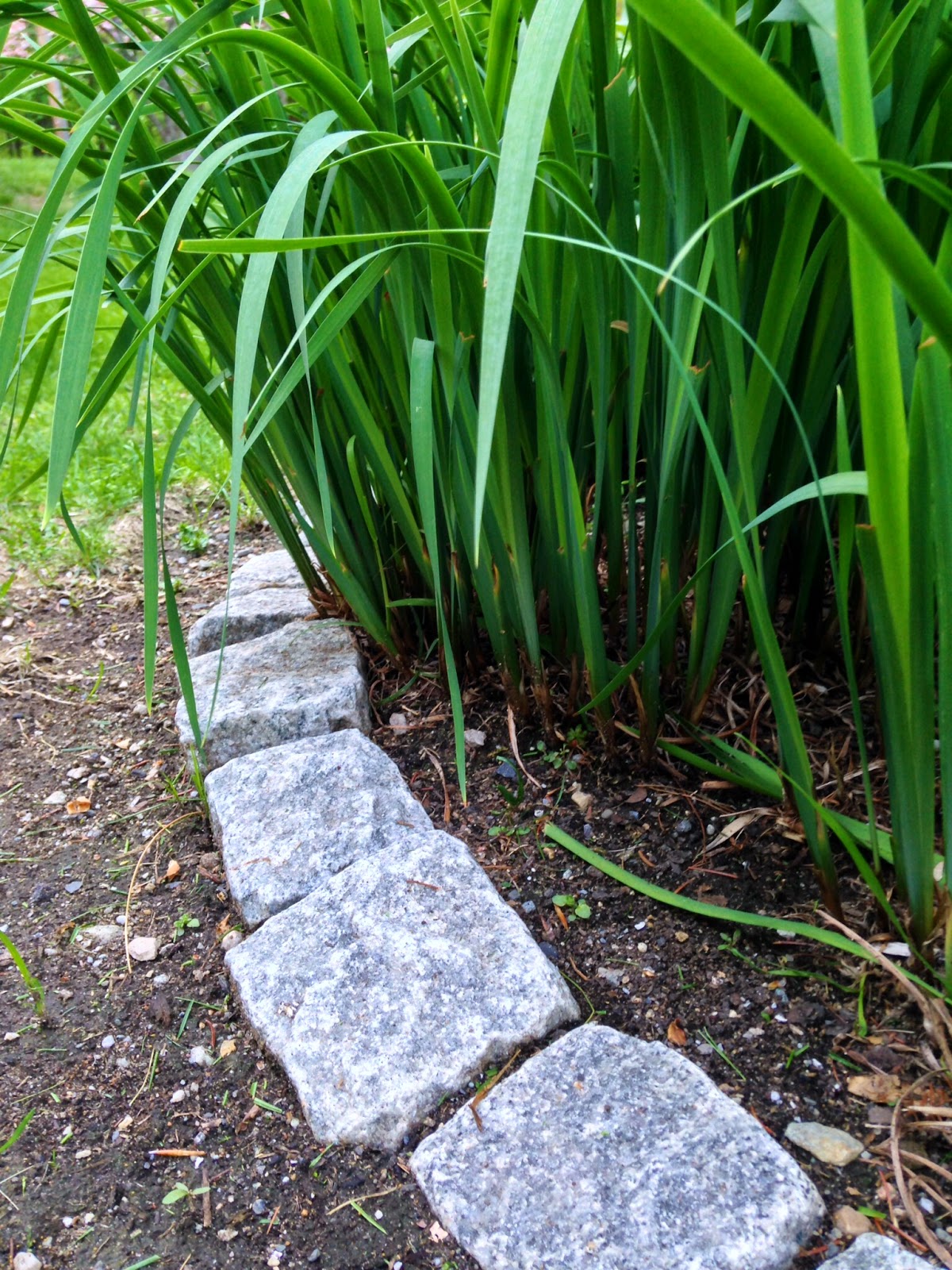
Granite cobblestone border
Good fences may make good neighbors, but they also make a person feel good herself. Dessert helps, too.

Monday, June 02, 2008

Weeds, never and forever

Pulling wayward lilies of the valley out of the lawn reminds me that a weed is commonly defined as any plant in the wrong location.

Some plants, though, I just can't consider to be weeds. Ever. The pristine blossoms of star-of-Bethlehem Ornithogalum umbellatum give it a free ride where ever it wants to go. Even smack dab in the middle of the lawn is perfectly okay.


Same goes for woodland phlox, jack-in-the-pulpit, and mayflower.


On the other hand, Japanese knotweed Polygonum cuspidatum is never welcome, any time or any place. After almost two years of battling this beast, I have practically eradicated all vestiges along the side property line. And, I am proud to say, without the assistance of herbicides--all natural, hand-pulled goodness. A few weak shoots poke up every few days, but nothing that can't be corrected by a gentle tug.


So I am happily too late to take advantage of these Japanese knotweed recipes offered by the New England Wild Flower Society

What is more primal than physically consuming your enemy? Bet these recipes taste delicious!

Thursday, May 29, 2008

Muguet des bois

May brings masses of lilies of the valley along the back of my little yard. How can you not love such simple blossoms? Even when dressed up in a bubbly goblet, they are the definition of innocence.


Their fresh-smelling scent recalls the drugstore perfume, "Muguet des Bois," that was our summertime spritz back when we wished we all could be California girls. Maybe those memories are why I don't mind the chore of weeding out stray lilies from the lawn years later.

Monday, November 12, 2007

Fall fruits, writ small

One of my tasks this weekend was to fertilize broadleaf evergreens: hollies, rhododendra, and pieris. According to "Horticulture," this feeding should be done about two weeks before the first frost. Since we hit hard below freezing last night, I figure that I'm late with my chores, as usual. I use about 5 lbs of HollyTone in the fall and close to 10 pounds in the spring.

As I walked from bush to bush--stopping along the way to sprinkle a few handfuls of fertilizer on a bed of pachysandra or over the lilies of the valley--I realized that this garden contains a lot of plants with berries and that those berries fruit in all colors.


Earlier this year, when the front foundation plantings were renovated, my savvy sister-in-law suggested Ilex meserveae "Blue Princess" and "Blue Prince" for this north-facing elevation. These berries testify to the happy home and compatible relationship these hollies have found.

Nearby grow a couple of black-berried Ilex crenata "Chesapeake." How could a Maryland native not honor a variety named after the Bay? Although maybe this holly would prefer a more southern clime, as it is terribly vulnerable to winter kill and begs for a hard pruning every spring.


Another Japanese holly that fares better is this large, late blooming Heller's variety Ilex crenata hellerii. It is just now sporting tiny creamy flowers.


Some of the first bushes that we planted 15 years ago were American hollies, both red-fruited female Ilex opaca "Christmas Tree" and, for company, a yellow-berried male Ilex opaca, variety forgotten.


Some of my favorite hollies are a pair of sparsely fruiting Ilex opaca. These two American hollies were among six softwood cuttings that my mother took a decade ago from hollies growing freely on my in=laws' Cape Cod property. Glossy, well-formed foliage--but all of three berries!

Monday, May 28, 2007

Memorial day

On this Memorial Day, I took a rest from my on-going battle against the Japanese knotweed invasion to remember some of the wonderful gardeners, past and present, whose horticultural gifts are flowering in my garden today.

First off, I have from my mother a multitude of lilies of the valley. These grew in an azalea bed next to her house in Maryland. For several years, she allowed me to take a big clump each spring. Now I have so many, they are popping up in my lawn.


Usually, they bloom in early May but this year they are a few weeks late. This woodland phlox (Phlox divaricata) hitched a ride with the lilies of the valley and has found a happy home at the front margin of the same bed.


These bluish mauve columbines were a gift from my work colleague and super New England coastal gardener, TRH, who received them from her father in the Midwest.


And from the same source comes the most hearty yellow iris.


My very horticulturally active sister-in-law kindly gave me a host of bi-colored irises. They bloom more lushly every year.


I am so grateful for all of these heirlooms!

Monday, June 19, 2006

Stake, edge, prune, stake, edge . . .

A few hours of the garden grind this weekend. The weather was unbearably oppressive, the mosquitoes were thirsty for blood, and all the beds needed attention.


Here's what I can check off on my "to-do" list: (1) stake the dahlia from VPS, Sr., that's visiting my new bed--what happened to its friend? (2) edge the back bed, trying to separate the grass from the creeping, burrowing, and arching profusion of lily-of-the-valley and sweet woodruff, (3) edge the daylily bed along the side of the house and sprinkle the plants with 10-10-10, (4) toss peat moss on the new bed and the front walk beds, (5) stake up the daisies and phlox at the back of the house and the daisies, ladybells, and phlox in the old side bed, (6) deadhead irises and columbines, and (7) weed, weed, weed. Payback time is far off!