Showing posts with label Siberian irises. Show all posts

Monday, June 05, 2017

Siberian irises, desparate remedies, and cultivating the art of renunciation

In order not to impact flowering, gardeners are typically advised to transplant Siberian irises in the fall. But what if your Siberian irises have very little impact anyway? What if that dense mat of knotted, fibrous plants is only yielding one or two blooms? Wait to see if more appear? Or plunge in with shovel and knife to carve out new divisions? That was the dilemma yesterday.


I opted for spring transplanting. The week ahead promises to be rainy and cool, so the weather is on my side. After shoveling up a mound, I pulled off groups of two or three outer, younger plants and briefly soaked their roots in water. I added a little composted cow manure and 10-10-10 fertilizer to the soil and poked these divisions back into the ground. Because it takes a year or two for transplanted divisions to flower, I limited myself to a single clump. Now that I see how desperately these irises need to be separated, I know that I have to continue to cycle through the garden clump by clump.

So, in foregoing a strong turn-out of Siberian irises this year and perhaps even next, I am reminded of Thomas Hardy's advice from his lesser novel, Desperate Remedies: “Cultivate the art of renunciation.”  And patience. 

Monday, May 19, 2014

Boundary issues

I have boundary issues. Not as in a lack of any boundaries--quite the opposite. I like boundaries. I like clearly marked property. I like name tags, monogrammed stationary, and signet rings. I like knowing what belongs to me and what doesn't. Don't even think about asking me to share my dessert.  It's not going to happen.

Garden boundaries not only mark off your bit of turf from your neighbor's, but they also organize all that green stuff into visually comprehensible blocks of lawn, bed, and hedge.

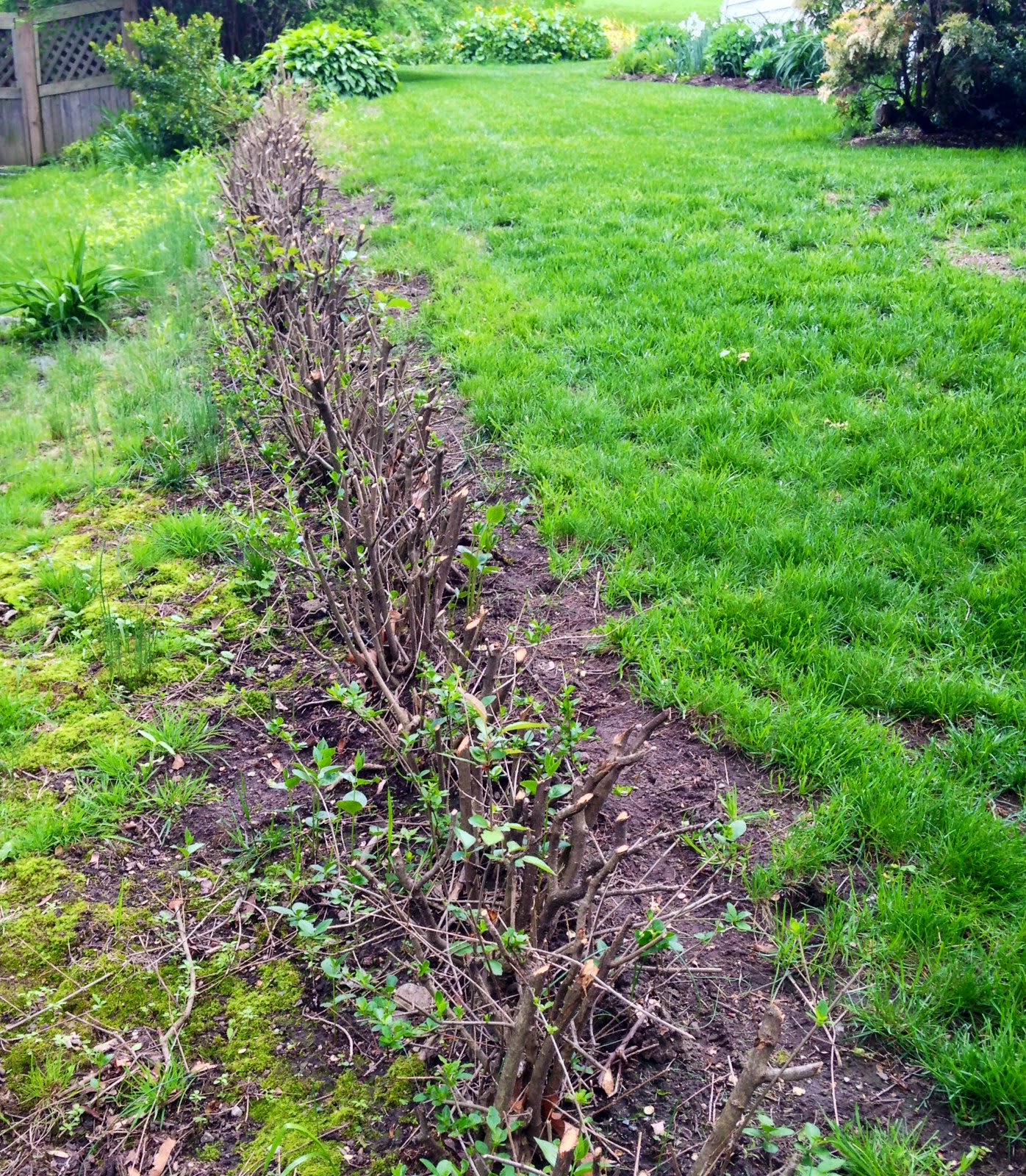
A line of privet separates one portion of the front yard from our neighbor's lot.  This hedge is homely, dead boring, and purely utilitarian, as all privet is.  Every few years the privet needs to be cut back hard in the spring in order to keep it from becoming tall and leggy.  Last weekend, it was snipped down to about a foot high.  Fertilizing, top-dressing, and edging are needed before it looks presentable.  Some new shoots and leaves would be helpful, too.

Pruned back privet

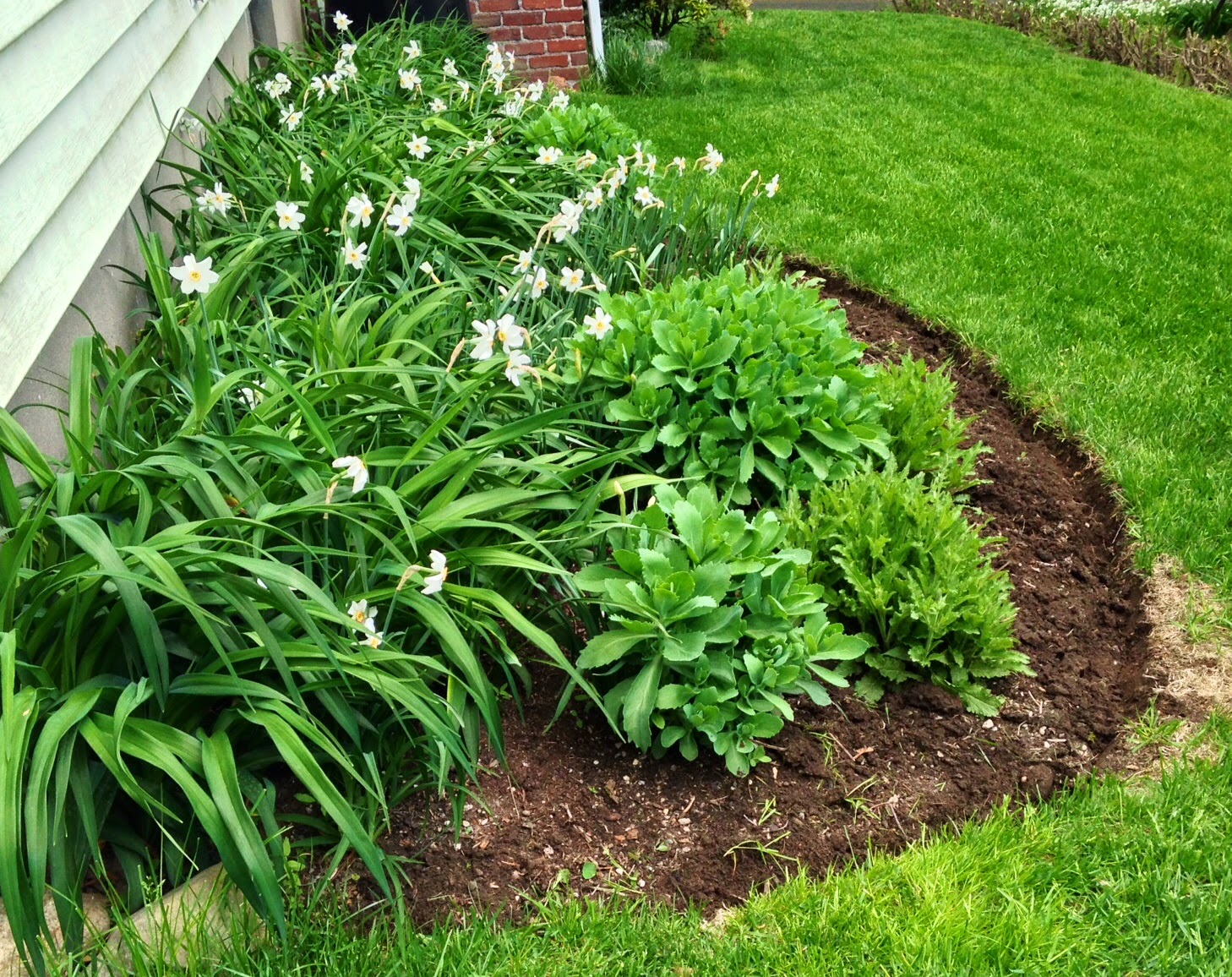
Yes, about edging. Using a half-moon edger, I try to border beds twice a year.  Nothing makes a garden look better tended (particularly if it is not) or eases the challenge of mowing along the border of a bed more successfully than a clean cut edge. And, visually, a bit of tidy edging brings into focus the break between a lawn's green even roll and the patterning of a flower bed.

Curving border along front walk
Received wisdom suggests that plants should sit anywhere from a few inches to a foot back from the edge of the bed.  I have found adherence to this rule to be a secret weapon in my mission to continually expand the size of the flower beds.  The plants grow larger so, hey, what can I do but cut a wider bed?  And, so, ugly patches of lawn are gobbled up.  In other words, not only will I refuse to share my dessert, but I'm likely to sneak a bite of yours!

Edging creep: the secret to silently expanding your flower beds
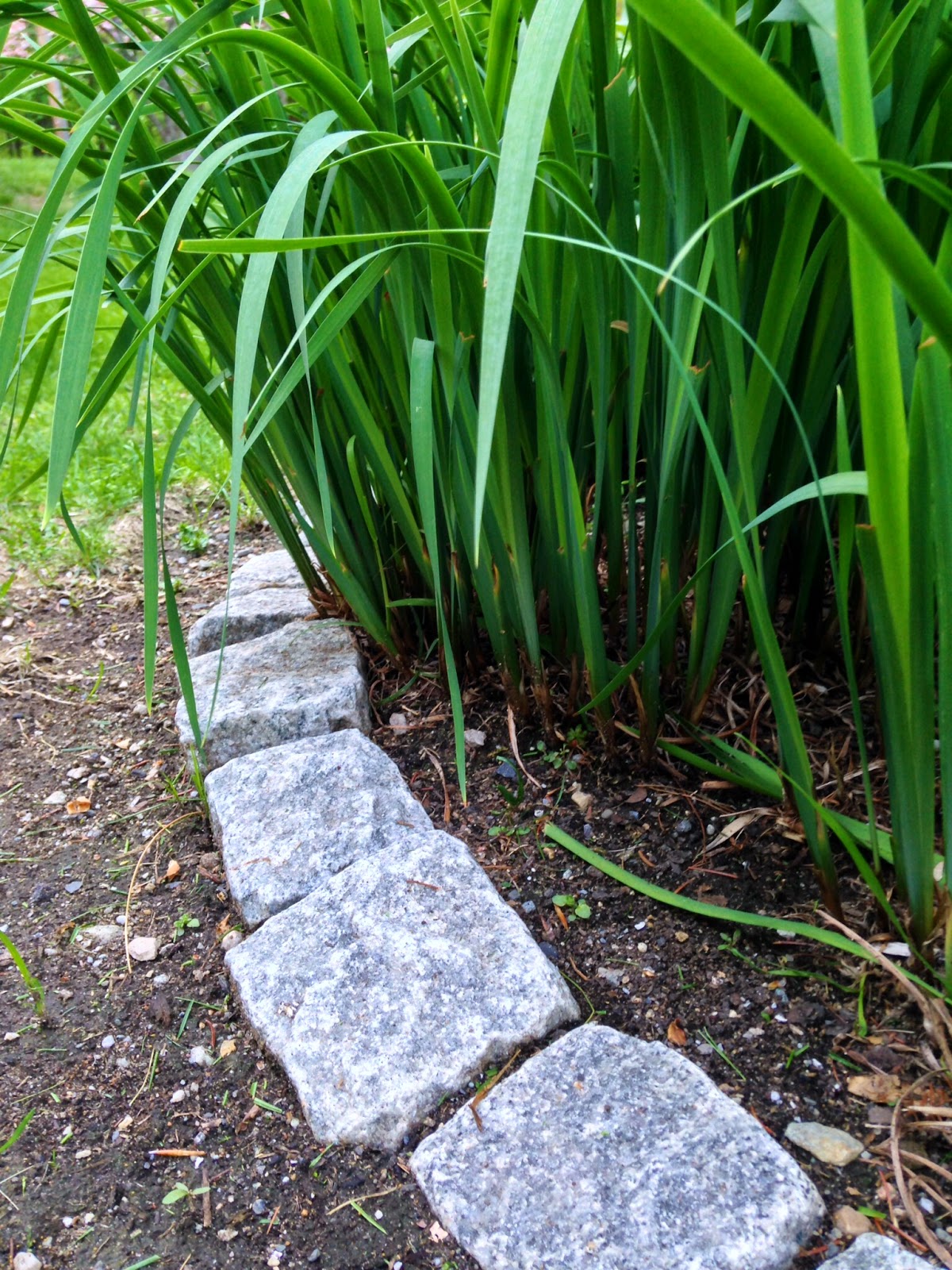
Sometimes a plain cut edge isn't enough, and the boundary needs to be marked more forcefully.  My parents used to call upon metal hoops and aluminum sheeting for this task--and I well remember the snarl of rusted junk to which those accoutrements inevitably decayed.  I've nevertheless considered resorting to sheet metal edging in order to stem the march of lilies of the valley from the back bed, but I'm not quite that desperate yet.  In the meantime, I limit myself to natural materials. Granite cobblestones, picked up at a local stone yard, add a line of contrasting color and texture to this bed of Siberian irises.

Granite cobblestone border
Good fences may make good neighbors, but they also make a person feel good herself. Dessert helps, too.

Thursday, June 05, 2008

Raingarden in action

Showers over the past few days have put the raingarden through its paces. The verdict? It works. At this early stage, it may not look like much--a little trench of muck holding rather ungraceful lines of irises, marsh marigolds Caltha palustris, mallows, and a scattering of black-eyed Susans Rudbeckia fulgida var. sullivantii "Goldsturm"--but there is greenery, growth, and even a few flowers.


These Siberian irises "Butter and Sugar" are lighting up one end. They were the more plebian but who-cares-because-they're-blooming substitution for the exotic but oh-so-unavailable-from-any-nursery "Aichi no Kagayaki" cross of Iris pseudacorus x Iris ensata that I had planned on planting.


Another eco-system joins the little patches of meadow and woodland in my backyard.

Monday, October 08, 2007

Columbus Day weekend

Perhaps it's a good thing that pre-existing obligations and inclement weather conspired to keep me out of the garden for much of this long weekend.


Upheaval, heavy machinery, and yellow tape are everywhere. The bed slated for bulb-planting now holds displaced Siberian and blue flag irises and lambs' ears.


A few beds still muster a block of end of season color.


Elsewhere, a final head of Phlox panticulata struggles on . . .


. . . and ladybells Adenophora confusa sends up a half-hearted stalk.


Dead-heading, weeding, and pulling out overgrown plants were the main order of business this weekend. How many bearded irises were found under the sprawling foliage of catmint and daisies!

The weather is definitely turning towards autumn. Almost every open flower on this dahlia had a blitzed bee stumbling over its pollen-rich surface. Last call!

Sunday, September 16, 2007

Yesterday's world

Yesterday, this corner of the garden was easing into fall.


Today, it is a hole. All part of a project to seal the foundation wall.


In between this horticultural being and nothingness, plants were moved to their new holding beds. Here are Siberian and bearded iris divisions awaiting re-planting.


No attempt was made at artful arrangement in their new beds. I just tried to keep various types of plants together so I will be able to assess how they look when it comes time to return them to their former homes. Next to a border of yews, I laid out a strip of Siberian irises "King of Kings" and heirloom peonies (dark pink to left, pale pink to right). These are all closer neighhbors than they should be but, heck, it's only temporary. I will separate the clumps that need to be to be separated when they return to their homes.


Yellow bearded irises joined others of different varieties by the rosebush and, along with a sedum and some daisies, squeezed into the new side bed.


I put aside several buckets' worth of daisies, sedum, and phlox to offer to fellow gardeners. And I noticed that someone had been stashing discarded old divisions behind the compost pile. Those thrifty Yankees!

The only upside to this project is that I will be able to convert the holding beds into growing space when their temporary inhabitants have been returned to their beds. What will I plant? More dahlias, for sure, and I'll show the delicious reasons why in a future post. Oh, I guess that it's healthy to renovate one's garden occasionally, too.

Life goes on.

Monday, September 10, 2007

Mood equation: n + (-n) = 0

Happy things:

1. September sedums and succulents, like a big bowl of Sedum rupestre (reflexum), Hen and chicks Sempervivum sp., and Sedum spurium "Fuldaglut."


2. The contrast of the slender leaves of Siberian irises with the tiny flower heads and foliage colors of sedums "Autumn Joy" and "Vera Jamison."


Unhappy things:

1. Harvesting buckets of rocks from new holding beds.


2. The reason for new holding beds: a foundation excavation in order to address periodic basement flooding. Most of the perennials in this bed will have to be moved. Oh, yes, a French drain is also being trenched through the adjacent lawn.


I'm just glad that my mood balance is at zero. That's a plus.

Monday, June 11, 2007

Irises, irises, irises

How fortunate that there is an iris for almost every corner of my yard.

In the drier areas and on the slopes, I grow bearded irises, like "Champagne Elegance," "Play with Fire," and several unnamed passalongs.


Just added this year from my sister-in-law's bounty comes a tall, graceful iris with lilac-striped falls, yellow beards, and white standards. This nameless variety catches the sunlight so well that it looks like it's glowing from within.


"Eric the Red," "King of Kings," and "Cambridge," Siberian irises, like to be in well-watered ground, particularly when they are setting flowers.


In the spring, I top-dress both bearded and Siberian species with peatmoss. After blooming, I cut down the stems to a few inches. The foliage remains until fall, when it is trimmed down to a few inches. I try not to over-fertilize but just can't help but scatter a little 5-10-5 around.

And the blue flag irises (Iris versicolor) keep their feet muddy in the soggy area of my former lawn. I haven't a clue how to care for them!


Tuesday, June 06, 2006

Siberian irises

The Siberian irises have been in bloom for a week and will probably continue for another. I love them but I'm not sure that the feeling is reciprocated. It's one of those uncomprending motherly devotions--I have absolutely no clue as to how or why these specific plants are affected by light, water, or fertilizer or by frequency of division. On occasion, I've separated and replanted a healthy clump, only to have the new plants disappear like a teenager silently easing out the back door.


I provide as much water as possible and mulch the irises in the spring with compost, peat moss, or composted cow manure. In the fall, I cut the leaves down to about three inches.

"Cambridge"


"Eric the Red"


"Caesar's Brother" (Thanks, AWC!)


"King of Kings"