Showing posts with label family history. Show all posts

Monday, July 04, 2011

Fireworks

Looks like the garden is celebrating this holiday weekend with a small scale fireworks display.  The red and coral blossoms of this trumpet honeysuckle Lonicera sempervirens "Major Wheeler" shoot out like tiny versions of those sky-shattering explosions.


In the past, I've grown sweet peas on this trellis, but this year, I missed the early spring planting out season for seeds, and later I couldn't locate any nursery-grown plants. The past few years, too, I've had real difficulty keeping the sweet pea vines from going bleached and brittle by mid-summer.  Flower yields have been less than impressive.  Anyway, all these thoughts were rattling around in my head as I wandered down the aisles of my local garden center wondering what to do.  As soon as I picked up a potted vine with the name "Major Wheeler," I knew I had my answer. 

The twisting vines of my own family history are heavy with military Wheelers.  No Majors, but lots of other officers.  To mark this patriotic day, here are a few.

Captain Wheeler (1796/1798-1867) 
Colonel Wheeler (1826-1901)
Lieutenant Wheeler (1895-1918)
  
They definitely set off fireworks in their own days.  And so did we!


Monday, March 03, 2008

Raingarden revisions revised

Showers are forecast for four of the next five days, which leads me to think about plans for my raingarden. Here is a revision that incorporates my first plant order of the season.


Can't wait for the weather to warm, skies to clear, snow to melt, and winter to be gone!

Tuesday, December 11, 2007

Viva, Mount Vernon, 1916


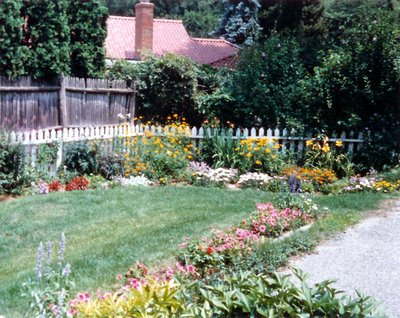
When recently sorting through some old photographs, I came upon this print of my grandmother in 1916. Anyone who has visited the gardens at Mount Vernon will immediately recognize the undulating picket fence and the sweeping grass path of the Upper Garden. "Straight is the line of duty, curved is the line of beauty," as the subject of this photograph would herself say.

Among the dense plantings, hollyhocks, iris, and peonies can be discerned. Another photograph shows oriental lilies in bloom.

This photograph so evokes the delights of this particular garden on a hot sunny summer day. And my grandmother, whose personal credo was "We'd have an easy life if it wasn't for our pleasures," seems to be taking her enjoyment seriously!

Sunday, November 18, 2007

Raking

Raking leaves is fall's familiar task. Here's how it was conducted in the Maryland suburbs, circa 1918: by well-dressed toddlers who had not quite mastered the finer points of how to operate their equipment.


Both of these apprentices--my mother and her sister--grew up to become accomplished gardeners. Maybe it was all those years devoted to perfecting their skills.

Up here in New England, the raking season is in full stretch and swing. Trees have shed about half of their leaves. Following the economy of effort school of gardening, I like to combine lawn mowing, yard waste removal, and leaf mold production into a single activity.


In other words, after running my mower a few times through the leaves I've piled up, I dump the shredded leaves onto my compost pile. There is never enough room for all this good stuff, so I stashed some of the excess in a tin tub before bagging the remainder for local composting.


Yes, as if the night frosts and short days didn't sufficiently spell out the season, fall has definitely arrived.

Sunday, June 03, 2007

Monnie's peonies

The peonies that I transplanted from my mother's garden two years ago have bloomed for the first time.


When I saw these full, frilly blossoms, I thought of their connection with my grandmother, Monnie.


Although she looks very solemn in this formal portrait, taken in St. Louis around 1909, I know from her diaries that this lively woman loved playing cards, riding horses, attending theatricals, and socializing with her seven siblings, numerous cousins, and beaux.

Monnie was relatively young when she died from a protracted degenerative illness. According to my mother, my grandfather never spoke about her--"because he loved her too much"--but he would take peonies from my mother's garden to lay on Monnie's grave on their wedding anniversary. I suspect that the story is rather more complicated than that of transcendent love, but who knows?

So now, linking three generations, sixty years, and four hundred miles, I have the same peonies growing in my garden.

Tuesday, May 29, 2007

Small pleasures

Some small pleasures tucked away in my garden are coming into bloom.

This dark-leaved coral bells Heuchera "Chocolate Ruffles" would be almost invisible if not for its fizzy white flowers. Because it's in the shadow of a yew, it's easy to pass by. You have to work a little for this pleasure.


What a delightful surprise to discover this wild columbine growing under the evergreens.


These reclusive blossoms remind me of childhood summer trips to the Chesapeake Bay. While my father was attending board meetings of a YMCA camp, the rest of us would explore the sandy bluffs overlooking the water. At the right time and with the right attention to one's surroundings, these red flowers could be glimpsed. They bring back memories of travelling in our tail-finned station wagon, scooping up sea nettles, and stopping for sherbet at a roadside stand with swinging screen doors and fruit machines.

Another wildflower that blooms without any human intervention is the mayapple. Every spring, a line of them forms along the back fence. I'm glad that they let me share their turf.

Friday, December 29, 2006

Gardening roots, Part II

Prune off those lawyers, lobbyists, and politicians, and my father sprouted from a farming tradition.

His grandfather from Aschbach, Alsace, was listed as a farmer on the manifest of the ship that brought him to New York in 1868 and again on the 1880 marriage license that united him with a Prussian farmer's daughter in Edwardsville, Illinois.

The narrow wedge backyard of the home that they built is now overrun with ground ivy. Who knows what it looked like a hundred years ago?


On another branch of my father's family tree, here's what my great-great aunt Annie had to say about how she and her sister, my great grandmother, Lillie, handled lawn care in 1880's Edwardsville:

Most of the home place was in bluegrass, especially the front yard where it grew high at times. Then it was mowed with a scythe. No lawn mowers then. On one occasion after it had been mowed, a number of spears of grass were left standing here and there. This was very disorderly according to my notion, and I resolved to remedy it. Securing a hatchet and Lillie’s aid, I began. The hatchet was dull, and the spears of grass were tough, so we took turns about, one using the hatchet and the other holding the spears of grass taut. When it was Lillie’s turn to wield the hatchet her force was better than her aim; consequently she nearly severed my big toe. We were both barefooted. The blood flowed freely, and we both ran into the house, Lillie doing most of the screaming as she thought she had mortally wounded me. The only thing else that I remember of this incident is that I sat with my foot in a wash-bowl of water all of the afternoon and that I chafed at the confinement and at the interruption of my interesting task.

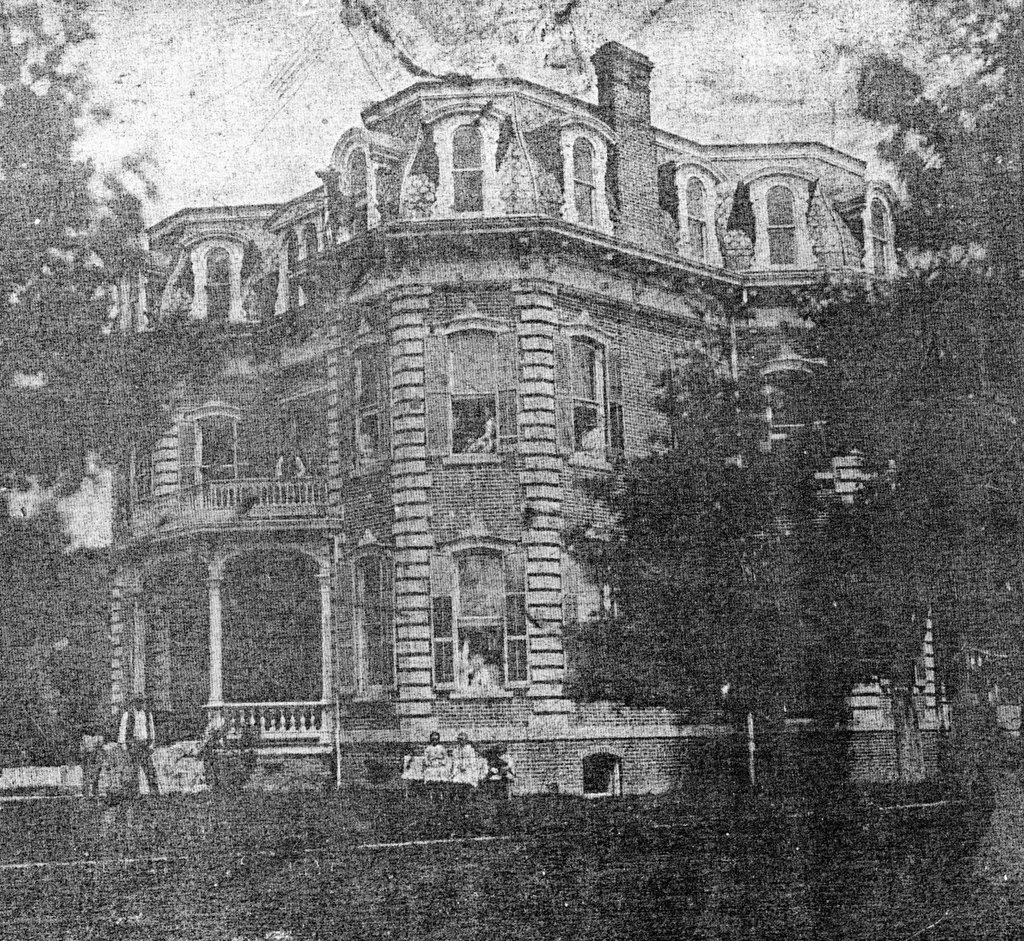
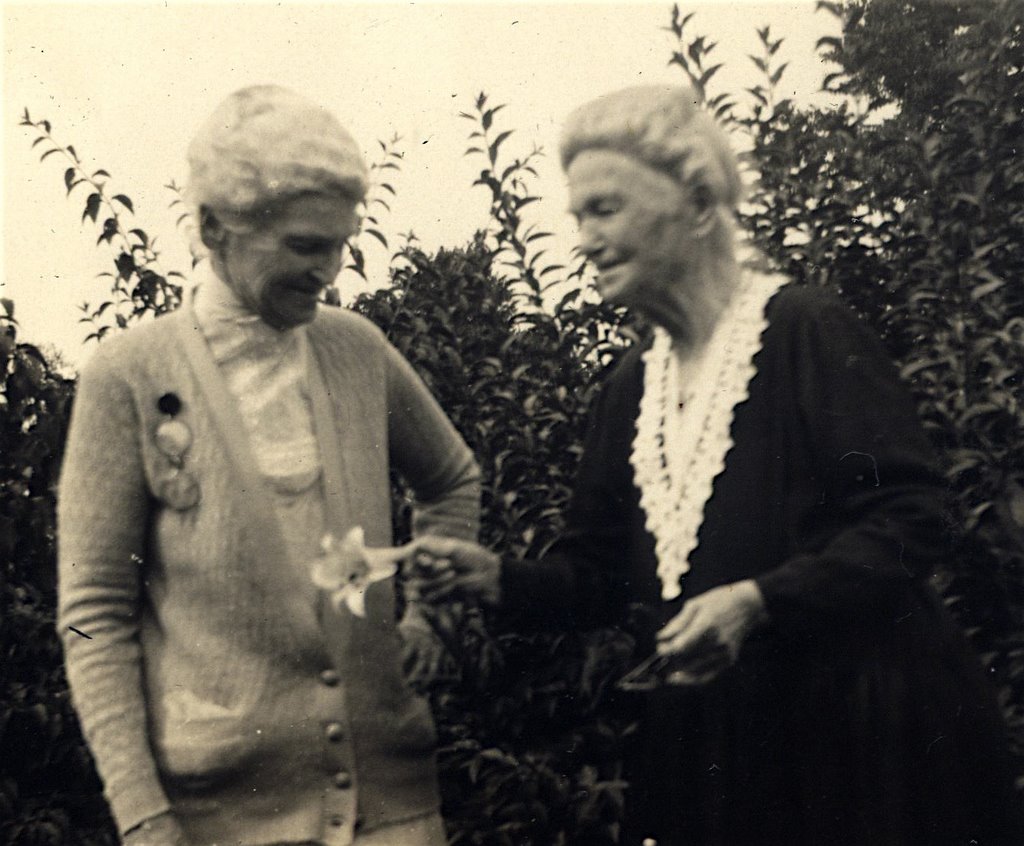
Perhaps the two gardeners are just visible in the upstairs windows of the home place in this 1880's tintype.


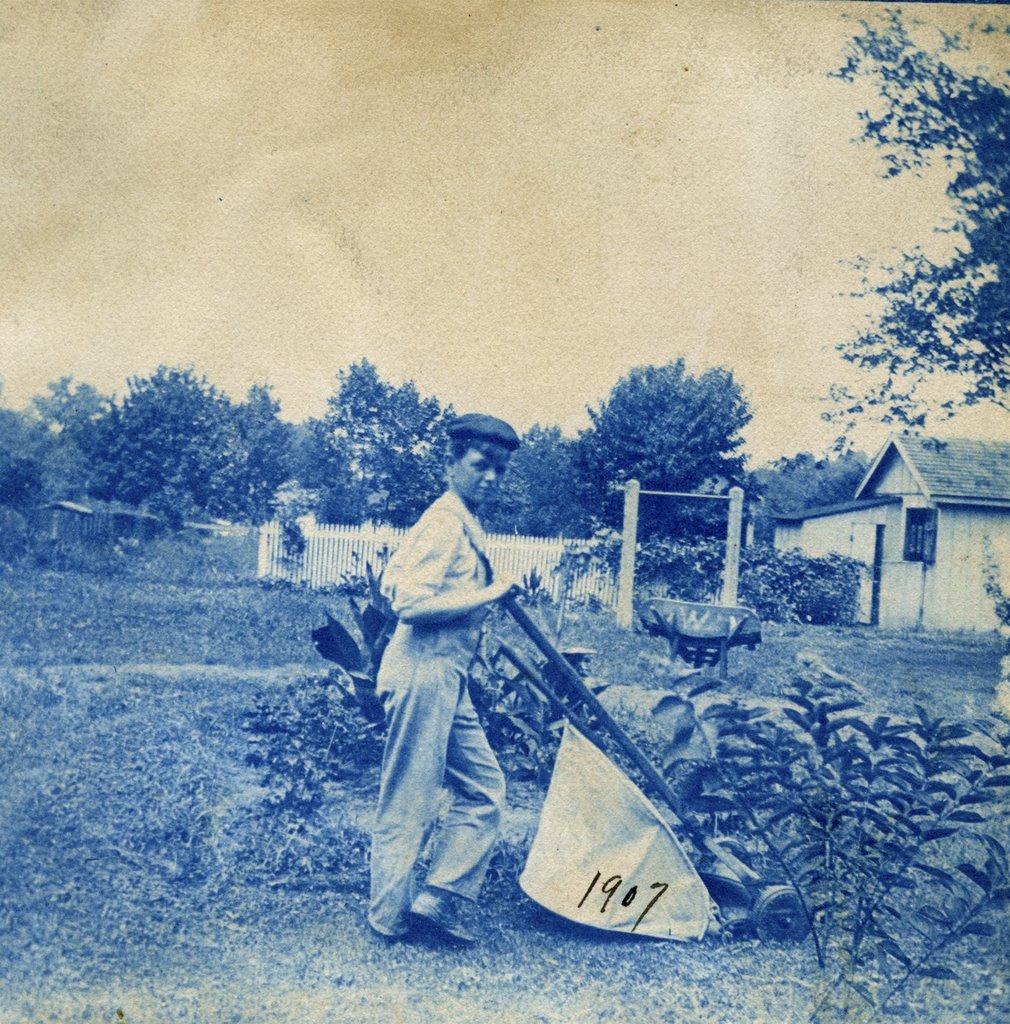
Twenty years later, in 1907, their nephew, Billie, was pushing a reel mower around that Edwardsville lawn.


And in 1913, my one-year old father was wading in a midwestern sea of grass.


While the children were tackling the lawn, the adults busied themselves with flowery pursuits. Sometimes, it was difficult to untangle the two, as my great great aunt, Annie, wrote:

Papa once had a special flower bed and he threatened to whip the next child who trod on it. The next day, when Mamma left the print of her foot in it, he didn’t know what to do. At dinner he said, “Mamma, after all my trouble, Alfred has stepped on my flower bed.” Mamma had to own up, since Alfred, our [hired] . . . man wore about number 13 shoes.

Here is my great grandmother, Lillie, inspecting her floral namesake with her dainty-footed mother, Piety (on the right).


Strange to think of these off-hand comments about gardens that no longer exist from people long dead.

Wednesday, December 27, 2006

Gardening roots, Part I

When winter arrives, I'm not one of those people who happily turns to domestic tasks. I hate to cook. I don't knit. And I sew only on an "as needed" basis.

But I am fascinated by genealogical research and could happily spend hours organizing papers, entering information in a computerized family tree, and poring through census, civil, and parish records.



So I got to thinking, what about other gardeners in my family? And before the concept of gardening had trickled down to the common folk, what about the plain old farmers--the cultivateurs, labourers, and Bauern--among my ancestors? Here's what I dug up.

In 1634, my eighth great-grandfather settled an eight-acre homestall in what was then Watertown, Massachusetts. His plot, about a half-mile from where I now live, today lies under suburban housing.


Later, he acquired land in the area of Beaver Brook


and Rock Meadow.


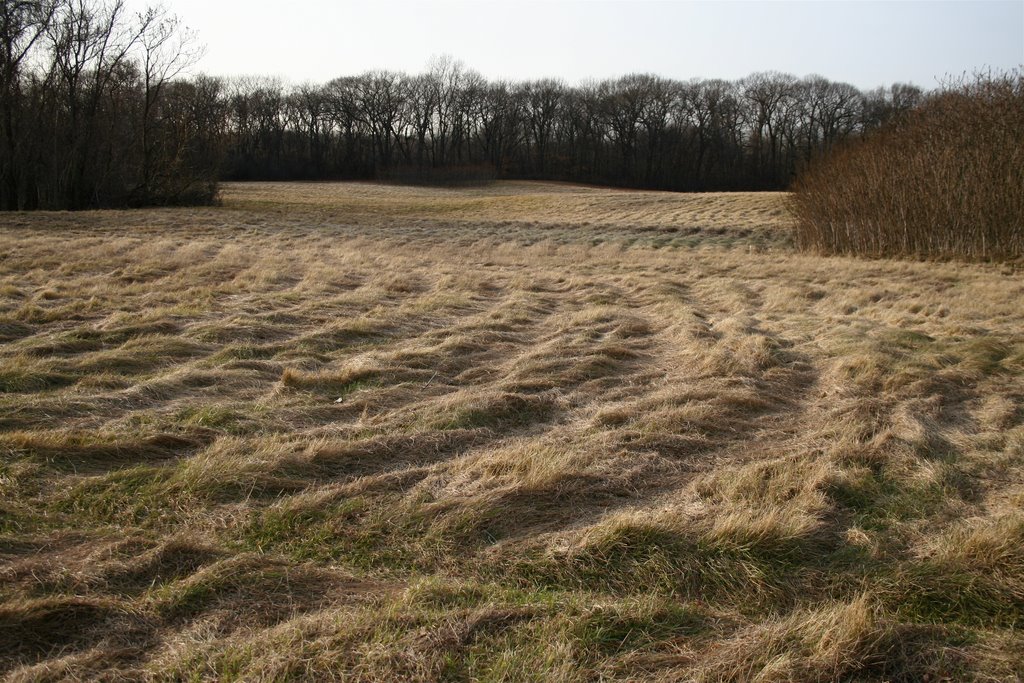
There is no record of what he farmed, but presumably this low-lying land served as pasturage. His will, written in 1685, mentions his house, meadow acreage and a barn in Cambridge Farms.

Fast forward about 300 years to my mother, a passionate tiller of her own back quarter acre. Her love of gardening may have grown from spending summers at her aunt's Connecticut house, where daily tasks included picking sweet peas and gooseberries growing next to the barn.


Years later, my mother marveled how it was that ever more flowers and fruit were waiting each morning. I think that realization somehow connected her with the potential of earth, sun, and rain.


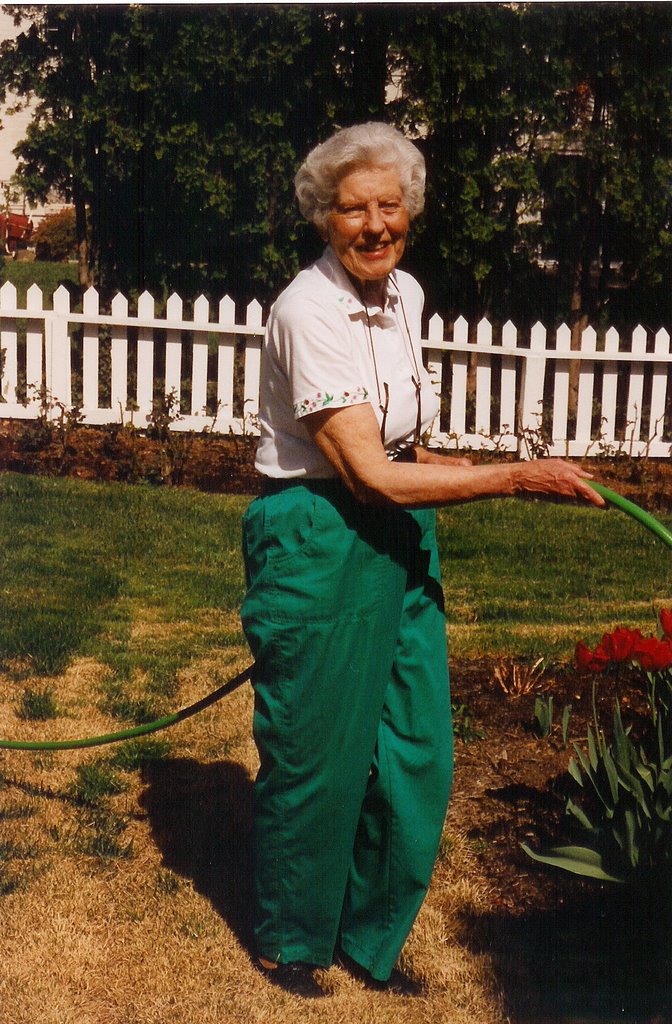
Back in her Maryland community, both she and her own mother belonged to the local garden club. Well into her eighties, she could be found spending six or more hours a day in her yard.

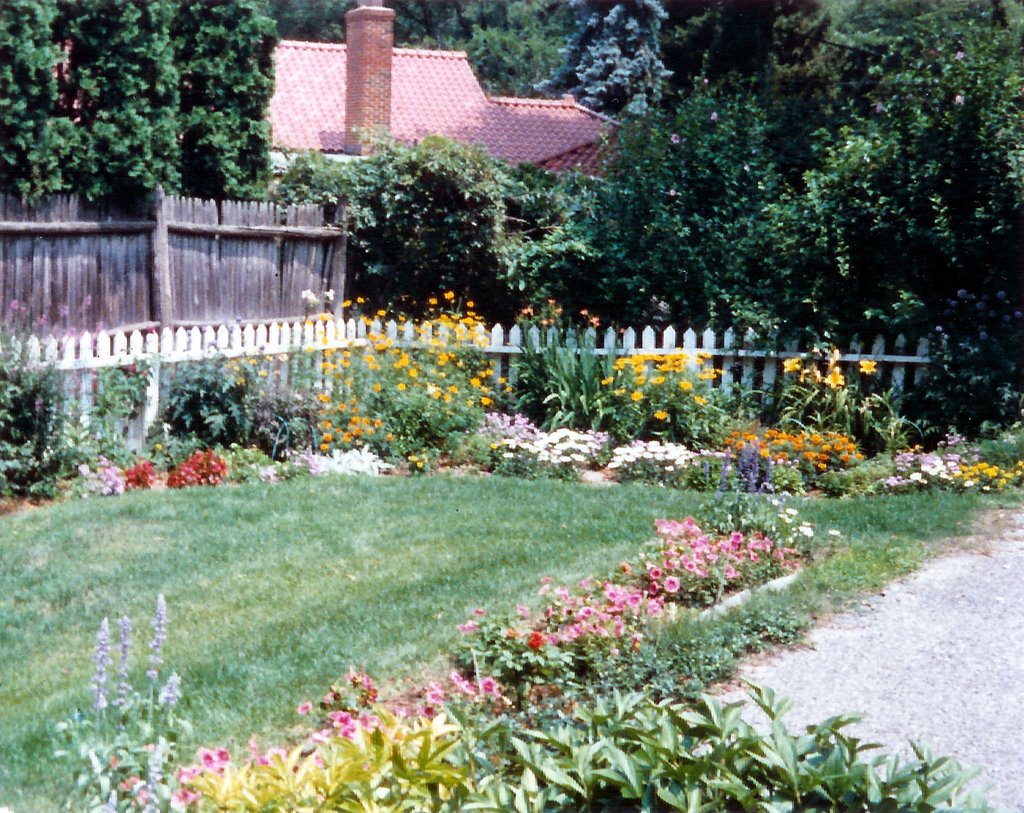
My mother was a yes-or-no kind of person, and her garden celebrated that same lack of nuance. She tolerated a few perennials and adored her roses, but through out the summer subsisted on the brightest of brilliantly colored annuals: petunias, salvia, marigolds, zinnias, and dahlias. Her garden was splashed with primary colors, particularly hot pinks, reds, oranges, and yellows. There was no subtle juxtaposition of contrasting textures, shapes, and colors--plants earned a place while in bloom and were expeditiously rooted out upon their decline. Unsentimental, cheerful, and practical. You can learn a lot about a person from looking at her garden.