Showing posts with label winter sowing. Show all posts

Friday, November 30, 2012

Seeding foxgloves in the fall

During a hike this summer, I happened across a woodland clearing scattered with common foxglove (Digitalis purpurea). The bright fuchsia shafts towered above yellow-flowering field.  

 
What a great addition to the mellow yellow foxglove (Digitalis grandiflora) that happily inhabits a shady corner of the yard, I thought.  


In the past, I've tried, without success, to grow "Apricot Beauty," another Digitalis purpurea cultivar.  Perhaps this wild pink version will be more robust than its finicky cousin.

 
Late November is a good time for winter sowing in New England. Preparations are pretty basic: dig some composted cow manure into a bare patch next to the existing foxgloves, remove the glass jar of seeds from the refrigerator, and scatter seeds over the turned soil. The seeds are very tiny, so surface sowing seemed the best way to go.  


Hopefully, by next summer these garish-colored blooms will evoke memories of hikes in the mountains.  Or, at least, an excuse to relax in the garden with a glass of Riesling and wedge of Munster cheese.

Tuesday, May 27, 2008

Mish-mash Memorial Day


It was a glorious long weekend for donning an old pair of tennis shoes, scruffy jeans and tee-shirt, and floppy hat, and for getting dirty in the garden. The siren call of sunshine, breezes, and mild temperatures beckoned every morning.

The mallow seeds that were started in a milk jug hot-house in early February finally departed the security of their recycled plastic home. Five small seedlings were transplanted into the raingarden next to a row of wet-footed Siberian irises, "Butter and Sugar."


Dahlias were planted in every spare corner. I am still feeling my way along this branch of esoteric knowledge . . . in the hopes of one day being sufficiently enlightened to successfully over-winter tubers. This spring's planting approach, however, involved nursery-bought tubers, a deep hole, a shovelful of peat moss, and a handful of bone meal for each tuber. Behind this curve of diminutive "Hawera" daffodils, a line of stakes anticipates the dahlias' emergence. In the old side bed and along the back of the house, other stakes mark subterranean dahlias.


I decided to wait to tease apart the various plant pairings that were thrown together in advance of French drain construction last fall. I am hoping for some serendipitous combinations, but so far, it's pretty much just a mish-mash, a mixed bag, of plants grouped together in haste. As glorious as they are though, some plants, like this robust iris, bully their their more self-effacing neighbors. Others, tucked behind taller cultivars, are lost in the shuffle.


One bed along the back of the house was amended with bonus dahlias "Raz-Ma-Taz" and "Rae Ann's Peach," helenium "Kanaria," red- and bronze-flowering snapdragons from the Rocket Series, and an unrepentantly vulgar purple Salvia splendens. Hard to believe that this mish-mash was actually planned. Hopefully, it will all harmonize in late August.

Saturday, February 02, 2008

Sowing for six more weeks

In the inverse logic of Groundhog's Day, today's sunny, mild weather means six more weeks of snow and ice. What better time to try winter sowing seeds? In a recent post, Carleton Gardener provided some links to this simple means of getting a jump on spring. And it sounded like just the treatment to combat seasonal affective disorder--or "seasonal defective disorder" as my son malaprops it. Yes, six more weeks of winter does seem rather defective.

Anyway, the basic idea here is to create little cloches or cold frames by recycling some of those plastic containers that end up anyway in the recycling bin. I started small with a gallon milk bottle.

After cutting the milk bottle in half and using my refined culinary skills to melt holes in the base with a hot fondue fork, I washed both parts of the bottle in a 1:10 bleach solution. A damp potting soil and peat moss mixture went into the lower portion.


Mallow seeds from Bestitched were scattered over the top and just covered with a little more potting mix. I'm not sure of these seeds' species or even genus--common mallow (Malva sylvestris), rose mallow (Lavatera trimestris), musk mallow (Malva moschata), whatever--but at least some varieties appear on lists of successfully winter sown seeds.


Join the top and bottom of the bottle with a belt of duct tape. Check out that high-tech HVAC system: holes covered by resealable duct tape tabs.


And then, outside it goes--here by a scrabbly mess of winter self-sown larkspur and over-wintering thyme. The south-facing location, while level, seems sunnier than the experts advise. Maybe that only matters once seedlings appear, between April and June, again according to the experts. Looking forward to the sight of those seed leaves!

Friday, June 23, 2006

Cora Leich's larkspur

These larkspur are happy interlopers next to the house. The original plant hitched a ride in a clump of shasta daisies transplanted from my mother's Maryland garden. My mother said that she had received the larkspur from a friend, Cora Leich, and that it would grow like a weed. She was right and then some: little larkspur plants can be found popping up in the lawn, sprouting in beds on other sides of the house, and even struggling in the darkness of the window wells.


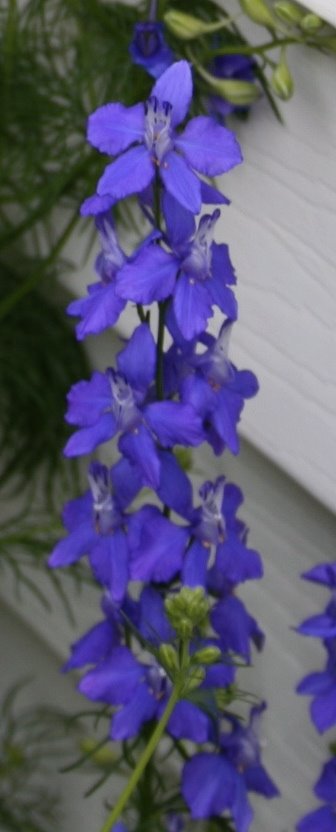
These plants have an open, pleasantly messy habit with numerous branches and delicate pinate leaves. One variety of larkspur produces deep blue flowers.


The other type blooms pink--just the same shade as the "New Dawn" roses.


What with all this liberal self-sowing, the only challenge is to direct the plants' efforts towards the desired plot of ground. When the seed pods have dried and begun to open, I collect as many seeds as possible. These are stored in the refrigerator until Thanksgiving Day. Half of the seeds are sown directly then and the remainder in early spring. They inevitably crowd themselves and, by late June, only the strong--or well placed--survive. Next year, I am looking forward to recapturing the space so gracelessly taken up by my (big) mistake.

My recollection may not be accurate, but I think that Cora Leich died about thirty years ago.