Showing posts with label roses. Show all posts

Monday, November 24, 2014

Hoarders

Not to get too personal, but certain members of my family have a hoarding issue. Well, one in particular. So, yesterday, when I saw an apple caught up high in the canes of climbing rose, I figured that our family hoarder had just parked a piece of fruit so that he could enjoy a snack later after completing his outside chores.  Our family hoarder likes to collect windfalls from a neighbor's apple tree, and this fruit looked just banged and bruised enough to be from that harvest.


But after our hoarder denied all knowledge, I thought back to the other caches of food that I've found in the boughs of this rose bush.  I think that this apple must be an example of hoarding from another branch of the animal family. My hunch is that this apple represented a grey squirrel's scatter hoard. The rose bush served as the perfect larder: the apple could be secured on a thorn, it was out of reach of hungry competitors, and the wrapping of prickly canes served as effective protection.
 
Sorry to spoil some creature's seasonal feast, but after pruning back the rose bush yesterday, the larder is no more. And, myself, I've hoarded the last few red rose hips for a fall arrangement.


Tuesday, January 22, 2013

Mulching after the holidays

After the holidays, when the ground is solidly frozen, is the best time to apply winter mulch.  As a seasonal bonus, discarded Christmas tree boughs can be used as a terrific insulating layer. The idea here is to create a stable micro-environment around the roots of the plant in order to prevent the soil from heaving during freeze and thaw cycles.  Roots do not like to be pulled and pushed, ripped and torn!  The micro-environment under the mulch layer buffers against the effects of severe and sudden temperature changes, allowing the plant to ease along through the winter season.

Tops on my list for winter mulching is the "New Dawn" rose. After its run-in with Hurricane Sandy, it's been reduced to a stand of bare canes.

This rose will definitely be pruned and shaped come spring but in the meantime, the canes have been lassoed in between a ring of study metal garden stakes.

A pile of evergreen branches is heaped over the base of the rose.  When the weather starts to turn warm--in an eternity from now, I fear--the branches can be removed, a bit at a time. Over-wintering dahlias are similarly protected.

Best of all, this mulch is free and, for a brief period, widely available as folks haul their old trees to the curb for pick-up. Yes, you don't even need to make use of your own Christmas tree! Typically, we celebrate around a table-top tree--this year, a dwarf Alberta spruce--which can spare no branches.  So yes, I'm that person who's leaning over her neighbors' discarded trees with a pair of clippers in one hand and an armful of cut boughs in the other. It's all in the holiday sharing spirit, right?


Monday, October 29, 2012

Dawn down

I was away in Philadelphia this weekend, so when I finally returned home last night--after running through four--four!--cancelled flights--there was little time to do much in the way of preparations for Hurricane Sandy.  My husband cleaned leaves out of the gutters, I brought in some potted plants, and we sheared back the "New Dawn" climbing rose so its trellis would catch less wind. Turns out that in the case of that last task, we were no match for Mother Nature: about a half hour into the storm, the trellis pulled free from the side of the house and smashed to pieces.


After the winds calm, the rains cease, and the canes are untangled from the lattice work, I'll be trying out a new technique for over-wintering this rose.  Maybe something with stakes and burlap?  Or a conical hoop and sheet foam?  Researching the options was a good way to pass time this afternoon--and to take my mind off the weeping beech branch poking through the attic roof.  Yes, we're pretty battered here.

Monday, June 20, 2011

"New Dawn": it's on!

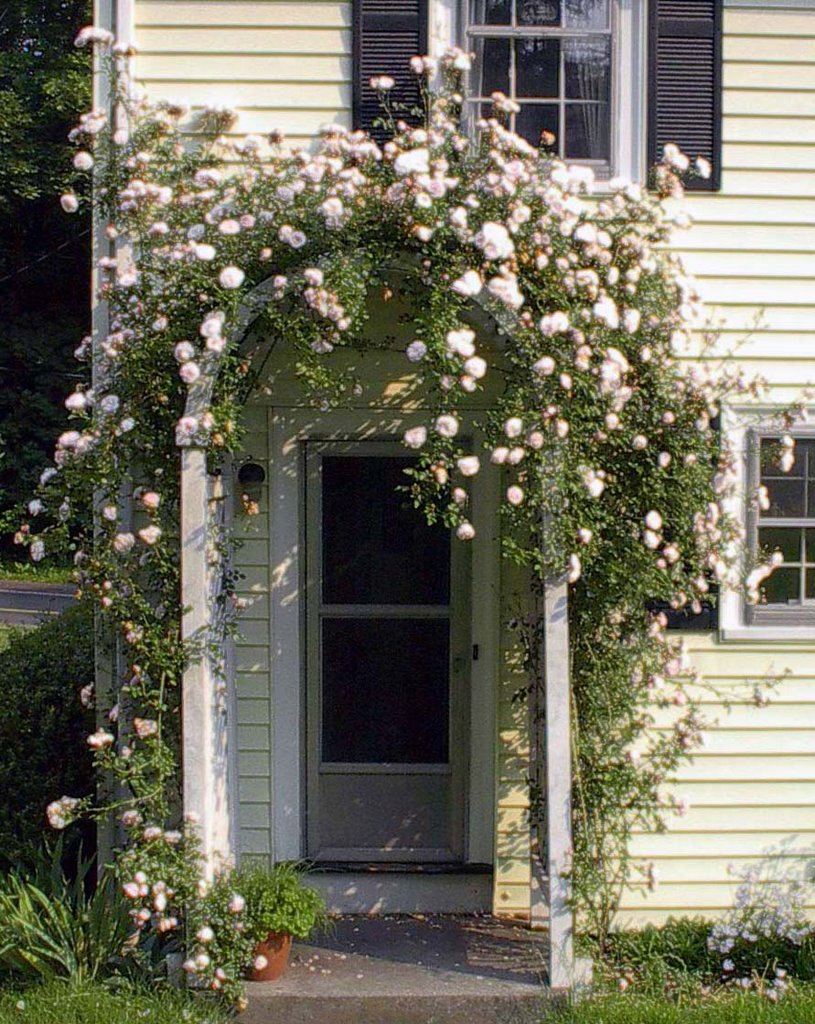
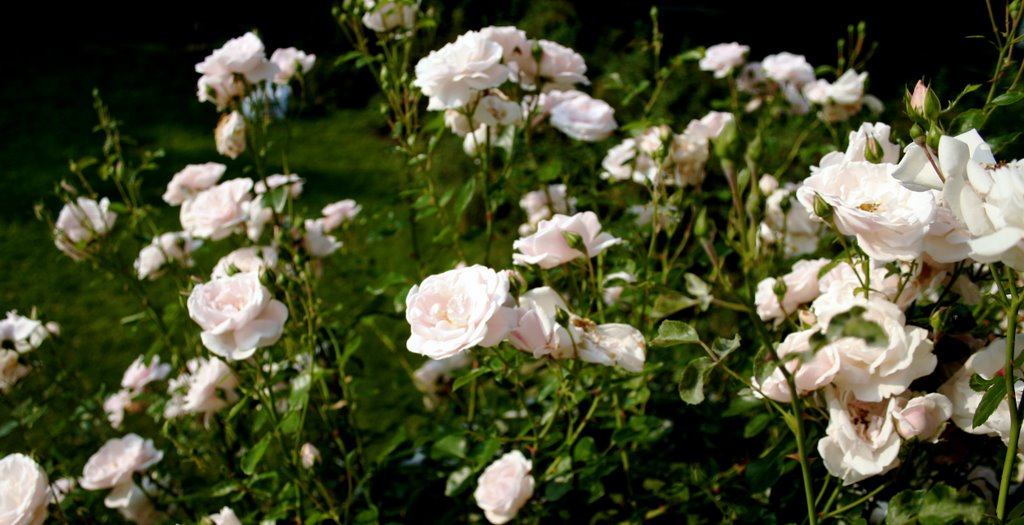
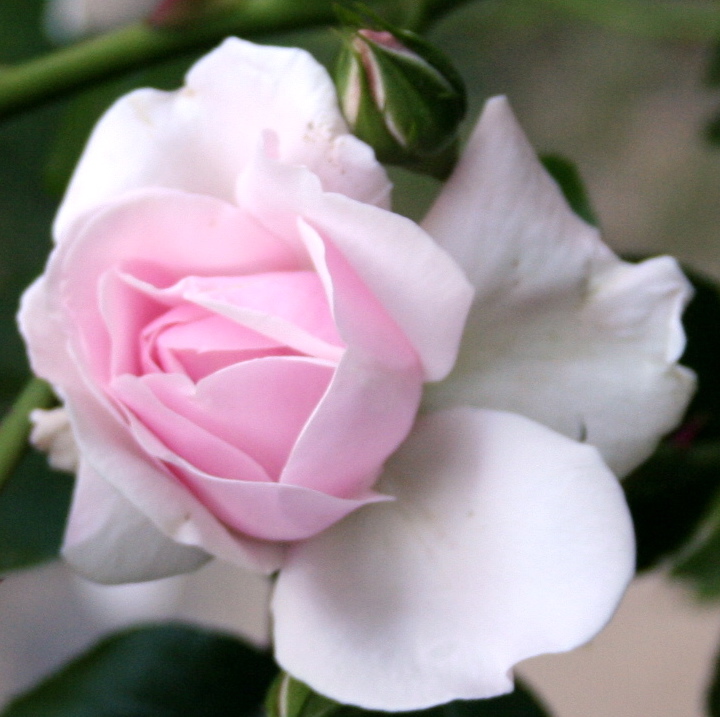
My "New Dawn" rose is celebrating its glory days. This plant is just perfect for its sunny space over the back door--robust enough to cover the arbor, softly colored to complement the house, and freely flowering enough to supply a near limitless number of bouquets.


Although claimed to be an everblooming rose, "New Dawn" really has one good shot and mid-June is it. However, with a little luck (and a bit of fertilizer), a few random blooms will continue to be thrown out until the first snowfall.


My care regimen for this rose is oh-so-simple.  By far the most challenging component is pruning, which is wrestled out only at the cost of several days of teetering on a ladder, buckets of sweat, and armloads of scratches.  Last year, I cut this rose back hard, and it totally paid off: no loss of flowering and a far better shape.

If only it had a stronger scent and fewer thorns!   Maybe not the best climber ever, but pretty darn good. 

Saturday, July 03, 2010

Hard pruning


"This thing is out of control," groused my husband as he slipped under a spray of "New Dawn" rose canes blocking his entry through the kitchen door.  "What the heck are you feeding that?" asked my neighbor from his yard next door.  "Yikes!" I thought when I saw the tussle of rose blossoms clambering up to a second floor window.


Such was the impetus for my most despised gardening activity: rose pruning.  I have to admit--as if I could claim otherwise in the flowery face of the evidence--that I had kind of let things go.  A couple of years, I really couldn't prune because I didn't want to disturb the birds nesting in the arbor.  Another year, it was just too dang hot.  My mother, an excellent rosarian, was no longer around to take up the task.   Meantime, canes sprouted, curved, flopped, and grew some more.


With several days of cool, clear weather forecast, I set to pruning every evening after work.  After more than five hours teetering on a ladder and after accumulating over five bags of clippings, I can say that I'm done.

It was hard to prune, and I pruned darn hard. My mother's rallying cry--"Whack it out!"--spurred me along.  She was a ferocious rose pruner--my tender-hearted father couldn't even bear to be around when she was wielding her clippers--and every time that I wondered WWMD, I knew the answer was cut, cut, cut.


Anything that was where it shouldn't be was snipped off.  (Almost all) distorted canes were removed.  Deadwood was clipped.  New canes were tied to the arbor.  A good 1 1/4 cup of Rose-Tone was scratched in around the roots.

And then, among the debris of shorn branches, there was even the thank you of a few last blooms!

Sunday, June 28, 2009

"New Dawn" rose care

Folks searching for information about "New Dawn" rose care are among the most frequent visitors around here. So, for those who are interested, my rosarian regimen is as follows.


The subject of this attention is a vigorous eight-year old "New Dawn" bush trained to a trellis that arches over my back door.

Fertilizing

May 1: Apply 1/2 cup of Epsom salts dissolved in 2 cups warm water to the roots of the bush. Epsom salts (MgSo4) are a good source of magnesium and sulfur. Without an extra shot of magnesium, this particular rose can show the signs of magnesium deficiency--yellowing of the leaves between the veins and leaf curling--due either to its poor soil or leaching from the nearby concrete house foundation.

June 1, July 1, August 1: Scratch a 1 1/4 cup of RoseTone around roots monthly. Up here in Zone 6, fertilizing later than August 15 risks promoting new growth that will not have sufficient time to harden off before killing frosts. Resist the temptation.

Pruning

Early spring, prune out winter-killed stems and other deadwood. Climbers bloom on the previous year's wood, so limit the trimming to just tidying up.

While in flower, deadhead spent blooms for appearance.


After flowering, the bush can be shaped.

At this time, do:
*Prune severely as soon as possible in order to direct energy towards the development of new canes and to support flowering for next year.
*Remove deadwood and spindly, ill-shaped, or old canes.
*Cut back laterals, the smaller branches growing from the upright canes, on the diagonal at 1/4 inch above the first group of five true leaves. Cut so that new growth will be directed away from the center of the plant.
*Train vertical canes to the trellis by tying with garden twine.
*In order to prevent abrasion against the stem surface, form the twine tie as a figure-eight looping between the stem and the support.
*In order to avoid crushing the stems, use by-pass rather anvil clippers.

But don't:
*Position canes to overlap or rub against each other, say the experts. And good luck with that thorny throw down!
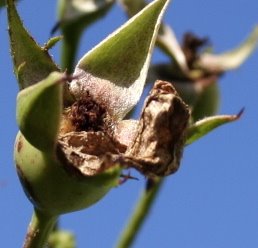
*Leave rose hips to ripen.

For me, pruning requires several afternoons teetering on a ladder--never pleasant under a hot summer sun--so I don't generally get around to this task until the weather starts to cool. By late fall, the plant is no longer throwing out new growth, and laterals have been trimmed to project 3"-5" from the vertical canes.

Mulching and watering

Rosarians say that plants require about an inch of water each week during the growing season. For me, the easiest way to meet this requirement is just a a few hours with a dripping hose.

Since this rose isn't sprayed with fungicides or pesticides, good hygiene is critical to maintaining its foliage and flowers. To avoid mildews, I don't spray the leaves. Before putting down any summer mulch, I clean up old leaves and other potentially disease-harboring debris. Also helps to be willing to accept a limited amount of black spot, aphid activity, and Japanese beetle damage.

Since I lost another "New Dawn" to a particularly dry, cold winter, I am careful to winter mulch after the ground has frozen in early January. I snug up evergreen boughs from discarded Christmas trees over the base of the plant to the height of about a foot. They come off slowly in the spring as the weather warms.


And then there's the reason that this variety has been going strong since it was introduced in 1930: it's plain and simple beautiful.

Monday, September 08, 2008

A nutty nest

This weekend's storms turned out to be underwhelming--not that I'm complaining, Mother Nature, you hear--so there were several sunny hours to be enjoyed out in the garden.

My New Dawn climber was way, way past its mid-summer pruning. In fact, some folks recommend not pruning this late in the season, in order to prevent the growth of tender shoots. But I think that a trimmed and tied up rose over-winters just fine--and poses less risk of personal harm from wind-whipped canes.


I had delayed taking to this climbing rose with ladder and clippers in deference to the family of robins nesting at the top of the arbor. And, also, pruning is difficult to do when there is still a spattering of flowers in bud and in bloom. This cultivar continues to throw off just enough flowers for it to be touted as "ever blooming."

Even though the robins disappeared in mid-August--flying out under the radar--imagine the cognitive dissonance when, peeking into their empty nest, I saw something small, green, and egg-shaped.


A butternut. Crazy! A squirrel must have scaled the arbor, negotiated the thorny branches, and cached the butternut for winter. Talk about squirreling something away! The butternut is still there, even after the pruning, should anyone need a snack.

Sunday, July 22, 2007

So this is summer . . .

What's not to love about a glorious summer weekend? My pleasures are simple. This chaotic medley of sanvitalia "Sunbini," Cape daisy Osteospernum "Lemon Symphony," yarrow Achillea x "Summer Wine," and mealy-cup sage Salvia farinacea "Victoria Blue" makes me smile.


Up close, it's clear why these plants are so compatiable. The dark eye of the Cape daisy echoes the blue of the sage and the maroon of the yarrow. Although not visible in this detail, the tiny yellow flowers and reddish stems of the sanvitalia add more depth.


Other sources of happiness: the ever-changing kaleidoscopic show of daylilies . . .


. . . and the first dahlia of the season, "Matthew Juul." After my very unsuccessful attempt to over-winter dahlia tubers, I am a convert to just treating them like annuals. Yes, I am totally lacking moral fiber. Easy way? That's the path for me!


What glorious weather it was for working in the garden. Long over-due tasks can now be checked off the list: tie up and fertilize the dahlias, deadhead the shasta daisies, mulch the summersweet and forsythia bed, spread compost around the base of the Pieris japonica and dogwood, prune and fertilize the climbing rose, and weed, weed, weed!

Sunday, June 17, 2007

Pinks of perfection

There are a lot of pink flowers in my garden. A real lot, especially since I don't consider myself a pink person. I put in one pink blooming plant, added another, then realized that a third would look great next to the others . . . and so on, down the slippery slope.

This deep pink peony is a division from a colleague's homestead in Vermont. (Thanks, SF!) The petals are a rich raspberry color with edges tinged almost silver. It's been slowly increasing each year--but won't we all take our time when we're 70 years old?


Perennial dianthus "Bewitched" rings the feet of another pink peony. By cutting back after the first bloom, I can usually extract a smaller second season. As well as its cheerful flowers, it boasts delicate blue-green foliage.


Self-sowing larkspur has moved closer to the similarly hue "New Dawn" roses.


Above the retaining wall in the front, little fuchsia Allium ostrowskianum are growing in a bed of white-flowering vinca.


Worth replanting bulbs every year!

Wednesday, January 17, 2007

Strategies for January

How to pull through the gloomy days of winter:

1. Thank the catalog companies for saving one's sanity with those over-the-top plant porn photos. Despite my resulting fantasies (to the extent allowed to a middle-aged member of "God's frozen people"), I've ordered only tobacco "Perfect Mix" (Nicotiana x sanderae) from Select Seeds and sweet pea "Old Spice" (Lathyrus odoratus) and evening primrose (Oenothera biennis) from Johnny's Selected Seeds. I am sticking to seeds that can be direct sown in the garden.

Okay, I did slip for a fuchsia "Gartenmeister Bonstedt," too. Caught me.

2. Turn the compost pile. At least, that thing is steaming!

3. Mulch the rose and peonies with boughs lopped off the Christmas tree on its way out the door. Finally, the ground has frozen, so it's time to insulate those roots under a deep spruce blanket.

4. Dream of summer . . .

Tuesday, August 01, 2006

And what about rose pruning?

Although the climbing rose "New Dawn" finished blooming last month--except for the on-going dribble of blossoms that earns this variety its "repeat bloomer" status--I pruned the faded flowers and swelling hips only last weekend.


When my mother was alive, she willingly undertook my rose pruning during her summer visit. An expert rosarian, her own bed of hybrid teas ran in a lazy curve along the back fence of her Maryland yard; ramblers were trellised up the sides of the house. In the summer heat, the scent of cut roses filled her house. Although restrained in her own personal habits, my mother relished fearlessly colorful varieties like "Tropicana," "Blaze," and "Mr. Lincoln."


My mother's cold-blooded conviction with the pruning shears was breath-taking. She ruthlessly pruned out old canes and weak laterals, commenting brusquely, "that will never amount to anything": all canes were cut at the correct angle one quarter inch above an outward-facing group of five or more leaves and new growth was aligned on the trellis.


During the year before my mother's death, her rose garden was untended. Black spot caused leaves to discolor and drop. Canes sprang up with unruly energy. Blossoms withered, and their petals scattered to the ground. Why, I wondered, did she choose to devote her energies to imperious plants so ill-suited to the Maryland heat and humidity? I could well have asked, why garden?

Friday, June 16, 2006

"New Dawn" rose

A "New Dawn" rose scales the trellis over the kitchen door and climbs to the floor above. Here, my view from the bedroom window finds the buds and blooms craning towards the sun. At the height of rose season, their scent seeps into the house.

As with Briar Rose's castle, in past years, the canes have insinuated themselves into the windows. Come October, putting in the winter storm windows becomes a serious challenge. My rose care is straight-forward. Every spring and fall, I dowse with 1/4 cup epsom salts dissolved in two cups of water. On the first of the month from June to September, I claw in 3/4 cup of Rose-Tone. If the leaves exhibit yellowing, which I think is chlorosis caused by lime in the adjacent foundation, I toss on a few handfuls of chelated iron. After the New Year, I winter mulch the base with evergreen boughs.