Tuesday, April 17, 2018

Garden goal roll, 2018

My blog may have withered away to a single annual posting, but at least it's one that serves me well. Every year, I pull together a post detailing what needs doing when, what worked and what didn't, and what I want to do in the future. 

Allium "Gladiator"

April

Dust peonies with copper fungicide to limit blight. Done 4/21/2017. Re-apply in June.

Top-dress spring-flowering bulbs with 3-5-3 when the leaf-tips emerge.  Started 4/7/2018; completed 4/1/2018.

Prune and clean up shrubs damaged by winter snows. On-going!

Treat daylilies infected by Aurebasidium microsictum fungus with Daconil (chlorothalonil)  every two weeks. Done 4/21/2017.  

Sprinkle with a little HollyTone to counteract lime leached from house foundation into flower bed around daylilies and evening primrose. Done 4/19/2018.


Larkspur seeds

Winter-sow larkspur seeds from Monticello. Done 4/14/2018. 

Shape "New Dawn" rose canes. And figure out a support structure.

Feed evergreens along front of house with Holly-Tone. Spread with 8 lbs. 4/19/2018.

Dose "New Dawn" rose with 1/2 cup of Epsom salts in 2 cups water.

Shape "Major Wheeler" honeysuckle slightly but hold off until after blooming to prune back hard to 50%. 

SWS' surplus irises

May

Plant dahlias. Dahlias arrived 4/19/2018!

Top-dress beds with composted cow manure throughout month. Started 4/21/2018.

Review spring bulb performance.  What needs to be replaced or amplified?

Set up front porch and garden table containers.

That stuff that you didn't get to last month?  Do it now.


June

Plant 3 Cathedral white salvia in bed at back of house.

Edge garden beds.


Mid-June:

Spray Pachysandra, periwinkle and rhododendron with Four Seasons horticultural oil to combat scale infestation. Spray again 10 days later.

Cut out deadwood from and thin spirea hedge.

Scratch 1 1/4 cups of RoseTone around the roots of "New Dawn" climbing rose now monthly through the summer; be sure to stop feeding by August 15 in order to prevent developing new growth that will not have time to harden off before fall temperatures drop.

After flowering, shear Amsonia hubrichtii by 1/3 of its height to promote better form. 

When it is 3 feet tall, cut Joe pye weed "Gateway" back to half its height to encourage dense growth.


Stake dahlias when the tubers are planted and again and again as they grow. Stop dahlias by pinching stem back to four pairs of leaves. 

Pinch back shasta daisies to 6". Or just get rid of them?

And stake, stake, stake!

Daylilies

July

After flowering, prune the "New Dawn" climbing rose. 

Prune back 50-80% of "Major Wheeler" honeysuckle after bloom is over.

Late August/Early September

Separate Siberian irises along bed at back of house as needed.

Time to order spring bulbs! 
*   Indoor at least 25 paperwhite narcissus bulbs and 2 amaryllis bulbs
*   Outdoor: 25 Gladiator allium


Columbus Day


Plant spring bulbs. 
  
Dig in bone meal around peonies.

Lightly feed evergreens along front of house with Holly-Tone.

Start forcing paperwhites indoors for Thanksgiving bloom.

Veterans Day

Top-dress beds with composted cow manure.

Late December

Start planning plant purchases for 2018.

Monday, June 05, 2017

Siberian irises, desparate remedies, and cultivating the art of renunciation

In order not to impact flowering, gardeners are typically advised to transplant Siberian irises in the fall. But what if your Siberian irises have very little impact anyway? What if that dense mat of knotted, fibrous plants is only yielding one or two blooms? Wait to see if more appear? Or plunge in with shovel and knife to carve out new divisions? That was the dilemma yesterday.


I opted for spring transplanting. The week ahead promises to be rainy and cool, so the weather is on my side. After shoveling up a mound, I pulled off groups of two or three outer, younger plants and briefly soaked their roots in water. I added a little composted cow manure and 10-10-10 fertilizer to the soil and poked these divisions back into the ground. Because it takes a year or two for transplanted divisions to flower, I limited myself to a single clump. Now that I see how desperately these irises need to be separated, I know that I have to continue to cycle through the garden clump by clump.

So, in foregoing a strong turn-out of Siberian irises this year and perhaps even next, I am reminded of Thomas Hardy's advice from his lesser novel, Desperate Remedies: “Cultivate the art of renunciation.”  And patience. 

Monday, May 01, 2017

Garden goal roll, 2017

My garden goal roll is more than just a "To Do" list.  Yes, this checklist is very definitely the way that I remember what needs doing when, but it also serves as my electronic diary, where I can record what worked and what didn't.  Sometimes that thing that didn't work is me: my personal rate of success in meeting my tasks is about 40%.  Thankfully, Mother Nature performs to a higher standard.

April

Dust peonies with copper fungicide to limit blight. Done 4/15/2017. Re-apply in June.


Top-dress spring-flowering bulbs with 3-5-3 when the leaf-tips emerge.  Done 4/5/2017.

Prune and clean up shrubs damaged by winter snows. On-going!

Treat daylilies infected by Aurebasidium microsictum fungus with Daconil (chlorothalonil)  every two weeks. Sprayed 4/18/2017, 5/3/2017, and 5/20/2017 (yellow leaves starting to appear). Replenish the bed with six plantings of Winsome Lady, a fungus-resistant variety from Oakes Dayliles. Planted 4/30/2017. Sprinkled with a little HollyTone to counteract lime leached from house foundation into flower bed.

Shape "New Dawn" rose canes. And figure out a support structure.

Feed evergreens along front of house with Holly-Tone. A little bit applied 4/30/2017.

Dose "New Dawn" rose with 1/2 cup of Epsom salts in 2 cups water. Applied 5/3/2017.

Trim "Major Wheeler" honeysuckle back.

Move sprigs of "Autumn Joy" sedum to front of bed by side of house. Done 4/30/2017.

May

Plant dahlias. (Along bed at back of house planted 1 x Touche (BBSC) 3.5' salmon/lavender, 2 x Ivanetti (BA) 3.5' purple ball, 2 x Totally Tangerine (AN)3.5' anemone orange, and 2 x Giggles (CO) 3.5' collarette orange/lilac, all from Swan Island 5/20/2017)

Top-dress beds with composted cow manure throughout month.

Review spring bulb performance.  What needs to be replaced or amplified? Add +/- 50 bulbs of tete-a-tete for front beds. Rotate in another batch of 25 "Gladiator" alliums in back bed against house.

Planted 6 Victoria blue salvia along bed at back of house.

Set up front porch and garden table containers.

That stuff that you didn't get to last month?  Do it now.


June

Planted 3 Cathedral white salvia in bed at back of house.

Edge garden beds.


Mid-June: spray groundcover with horticultural oil to combat scale infestation. Spray again 10 days later. Pachysandra, periwinkle and rhododendron sprayed with Four Seasons horticultural oil 6/10/2017.

Cut out deadwood from and thin spirea hedge.

Yellowing leaves of evening primrose treated with handful of garden iron applied to soil and leaves drenched with Miralcid acid-loving fertilizer 6/9/2017. 
Scratch 1 1/4 cups of RoseTone around the roots of "New Dawn" climbing rose now monthly through the summer; be sure to stop feeding by August 15 in order to prevent developing new growth that will not have time to harden off before fall temperatures drop.

After flowering, shear Amsonia hubrichtii by 1/3 of its height to promote better form. 
When it is 3 feet tall, cut Joe pye weed "Gateway" back to half its height to encourage dense growth.

Stake dahlias when the tubers are planted and again and again as they grow. Stop dahlias by pinching stem back to four pairs of leaves. 
Pinch back shasta daisies to 6". Or just get rid of them?

And stake, stake, stake!

July

After flowering, prune the "New Dawn" climbing rose. 

Prune back 50-80% of "Major Wheeler" honeysuckle after bloom is over.

Late August/Early September

Separate Siberian irises along bed at back of house as needed. Group at center separated 6/4/2017.

Time to order spring bulbs! 
*   Indoor at least 25 paperwhite narcissus bulbs and 2 amaryllis bulbs
*   Outdoor: 25 Gladiator allium

Transplant peony in shaded old side bed to sunny spot at back of house.

Columbus Day

Plant spring bulbs. 
  
Dig in bone meal around peonies.

Lightly feed evergreens along front of house with Holly-Tone.

Start forcing paperwhites indoors for Thanksgiving bloom.

Veterans Day

Top-dress beds with composted cow manure.


Late December

Start planning plant purchases for 2018.

Monday, November 07, 2016

Fall reckoning

A few Indian summer flowers have been finally harvested. This last bouquet offers a reckoning of the season's successes and failures, starting with the blooms arranged in a recycled Tianjin 天津冬菜 jar.

Pickle-pot posy
Dahlias: of several planted, only Kelsey Radiance bloomed.  The others suffered insufficient sunlight, uneven watering, the predations of rabbits.
Next year: just stick to low dahlias in the old side yard.

Salvia farinacea: "Victoria Blue" deserves strong representation in the garden.
Next year: what about adding a white-flowering annual variety, such as "Evolution," "Victoria White Series" or "Jewel White"?

Day lilies: For several--well, for several several--years, the daylilies have been infected by leaf streak caused by Aurebasidium microsictum fungus. At the end of the summer, I sprayed the foliage with Daconil (chlorothalonil) both after cutting down and again when re-growth appeared.
Next year: continue with the Daconil treatments every two weeks and replenish the bed with new fungus-resistant daylilies ( Betty Bennet, Edna Spalding, Ella Pettigrew, Globe Trotter, Nancy Hicks, Pink Superior, Ron Rousseau, Sudie, Tropical Tones, Upper Room, or Winsome Lady).

Streak, blight, fungus . . .

Sedum: Pinching and trimming back is better than not doing either, but that luxuriously full and rounded mound remains elusive. 
Next year: no reason not to shift stragglers lurking around the compost area into real beds.

Compost pile kabocha?
 
And speaking of the compost pile: despite the continuing challenge of balancing dry/wet, green/brown, kitchen scraps/everything else, one discarded seed sprouted out between the bin openings, flowered, and set a cute kabocha squash. Success!
 

Tuesday, June 21, 2016

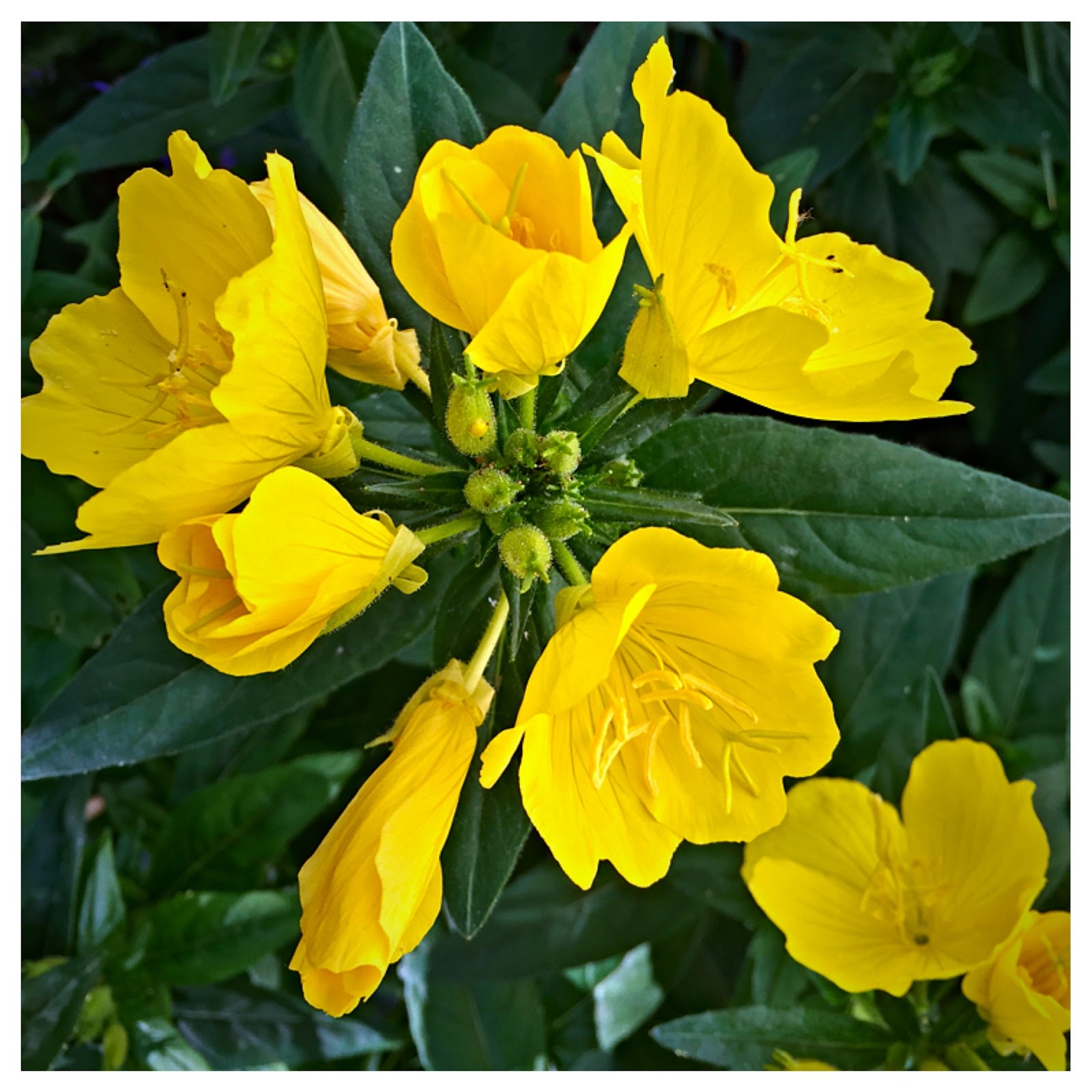
Good morning, evening primrose!

What is better than a serendipitous plant discovery?  Maybe receiving a gift of that serendipitous plant discovery!

Evening primrose (Oenothera sp.) in the morning

Common evening primrose (Oenothera biennis) has been on my wish list for years.  Although this American native appears variously as plants tall and short, lovers of damp or dry soils, and with blooms of white, pink, and even blue, my heart was set on a finding a well-behaved specimen that approximated the wild yellow-flowering version.

So how happy was I that last Independence Day weekend my sister-in-law offered a few seedlings of the sunny yellow specimens from her Maine coastal cottage garden in gratitude for a morning of weeding?


Pulling weeds, Harpswell, July 2015

Of the four seedlings that I transplanted, only the one best situated survived our winter. In bloom, it lights up a semi-sunny, well-drained bed.


While this nameless charmer might be a member of the genus Oenothera, I'm not sure of either species or variety. I'm guessing Oenothera fruticosa by reference to its size, leaf shape, soil preference, and sunny disposition. My only regret is that, despite the name, this evening primrose's yellow flowers are usually folding up by the time that I get home.

Closing up for the night
 

Monday, June 13, 2016

Compost challenges and cures

Throughout the winter and spring, we've dumped banana peels, kohlrabi parings, and melon rinds into our compost bin. What's the result of such environmentally-friendly diligence? Have we been rewarded with the gardener's black gold: crumbly, fine-textured, and earth-scented compost? Sadly, no. Instead, I have a pile of slimy, wet, malodorous muck. It looks and smells like . . .  yes, that's right. You don't want this stinky, sticky stuff on your skin, on your clothes, or in your garden.

What to do? The solution is simple. The green/brown or nitrogen/carbon balance of my compost pile is out of whack.  The recipe should be 1/3 nitrogen to 2/3 carbon but, during the cold months when green nitrogen-rich kitchen scraps rapidly accumulate, that ratio is difficult to meet.  To redress the situation, I need to add carbon-rich, absorbent materials. I use whatever I have at hand:
  • Shredded paper towels and newspaper (no glossy inserts or magazines!)
  • Dried grass clippings or lawn thatch
  • Fireplace ashes
  • Shredded leaves
  • Pine needles
  • Dryer lint
Shredded paper towels
To re-charge the process of decay, it's important to aerate the compost. A handled edging tool is great for slicing down into the pile, twisting, and lifting. Once lightened up, a spading fork does the job just fine. Turning over the pile mixes up the carbon and nitrogen components, encourages the growth of bacteria, and provides a good upper body work-out. 

Well-mixed and warming up
I'm not a big fan of dumping unfinished household compost on garden beds--why have the smell of raw sewage compete with that of roses and lilacs?--but it can be done. Since adding a few loads of carbon materials last week, this pile is percolating. I'm hoping that by the time that fall top-dressing rolls around, my compost will be cured.

Self-sowing cantaloupe seedling peaking out of the bin.

Tuesday, June 07, 2016

Garden goal roll 2016

My garden goal roll is more than just a "To Do" list.  Yes, this checklist is very definitely the way that I remember what needs doing when, but it also serves as my electronic diary, where I can record what worked and what didn't.  Sometimes that thing that didn't work is me: my personal rate of success in meeting my tasks is about 40%.  Thankfully, Mother Nature performs to a higher standard.

Rhododendon "Lodestar"

April

Dust peonies with copper fungicide to limit blight. Done 3/31/2016.  Re-apply in June.

Top-dress spring-flowering bulbs with 3-5-3 when the leaf-tips emerge.  Done 3/27/2016.

Prune and clean up shrubs damaged by winter snows.

Shape "New Dawn" rose canes. Done 5/15/2015. And figure out a support structure.

Weed and move lambs ear to new back bed.

Feed evergreens along front of house with Holly-Tone.

Dose "New Dawn" rose with 1/2 cup of Epsom salts in 2 cups water.

Trim "Major Wheeler" honeysuckle back.

May

Plant dahlias. Three Rose Toscano tubers planted at back bed against house on 6/5/2016.  Three Kelsey Radiance and one Kelsey Kristie dahlias planted in old side bed on 6/5/2016.  Two Uptown Girl tubers planted together at back bed against house on 6/12/2016. One Lights Out tuber planted in old side bed on 6/12/2016.

That stuff that you didn't get to last month?  Do it now.

Top-dress beds with composted cow manure throughout month.

Review spring bulb performance.  What needs to be replaced or amplified? Need +/- 20 tall purple alliums for back bed against house and +/- 200 miniature fuchsia alliums for beds along front walk.

June

Move potted amaryllis bulbs outdoors and feed regularly with liquid fertilizer.

Broadcast 5-10-5 fertilizer over flower beds and toss Holly-Tone on pachysandra and front foundation plantings on 6/12/2016.

Edge garden beds.

Prune into shape front foundation plantings and yews along side property line. Yews will be pruned by neighbor's landscaper. Privet hedge along property line cut back hard to 1' on 6/4/2016.
 
Scratch 1 1/4 cups of RoseTone around the roots of "New Dawn" climbing rose now monthly through the summer; be sure to stop feeding by August 15 in order to prevent developing new growth that will not have time to harden off before fall temperatures drop. First feeding 6/5/2016.

After flowering, shear Amsonia hubrichtii by 1/3 of its height to promote better form. Done.
 
When it is 3 feet tall, cut Joe pye weed "Gateway" back to half its height to encourage dense growth. Done 6/5/2016.

Stake dahlias when the tubers are planted and again and again as they grow. Stop dahlias by pinching stem back to four pairs of leaves. 
 
Pinch back shasta daisies to 6". Or just get rid of them?

And stake, stake, stake!

July

After flowering, prune the "New Dawn" climbing rose. 

Prune back 50-80% of "Major Wheeler" honeysuckle after bloom is over.

Late August/Early September

Separate Siberian irises to left of kitchen door (Eric the Red). Done August 27.

Time to order spring bulbs! 
*   Indoor at least 25 paperwhite narcissus bulbs and 2 amaryllis bulbs
*   Outdoor: See above!

Columbus Day

Plant spring bulbs. Done October 23: 25 "Gladiator" alliums in back bed against house and 100 fuchsia oreophilum alliums and 10 "Katherine Hodgkin" miniature irises along front walk.
 
Dig in bone meal around peonies.

Lightly feed evergreens along front of house with Holly-Tone.

Move potted amaryllis bulbs indoors and chill in refrigerator. Abandoned this effort.

Start forcing paperwhites indoors for Thanksgiving bloom.

Veterans Day

Top-dress beds with composted cow manure.

Late December

Start planning plant purchases for 2017.

Monday, April 04, 2016

Spring uncertainties

I'm thinking of Robert Frost's "A Prayer for Spring" on this early April day:

Oh, give us pleasure in the flowers today;
And give us not to think so far away
As the uncertain harvest; keep us here
All simply in the springing of the year.

Pansies and tulips last week . . .

Because with the uncertainties of a New England spring, it's difficult to look beyond what blows in with the next change of weather.  Thoughts of harvest are very far away on this snowy day.


The same, today

Friday, April 01, 2016

Weeding weather

When spring starts to shift gears, the siren song of the garden becomes irresistible.  The temperature rises, the days lengthen, and dirt finds its way under one's fingernails. I think that the scent of turned earth--petrichor perfume--is just as hard-wired to happiness as the smell of baking bread, Chanel No. 5, or freshly-mown grass.

As soon as the soil warms, early spring is a great time to weed.  The plants that need to be removed can be easily pulled, and the ones that need to stay haven't yet ensnared weeds in their roots or secreted them in their foliage.

Sprouts from left to right, top to bottom: sedum, monarda, stachya, marsh marigold/moss/grass, dicentra, lovage, mystery, sedum, iris reticulata

This spring, I have two major weeding campaigns to conduct: (1) a recently added beebalm (Monarda "Pink Lace") has exposed its mint family breeding by aggressively and indiscriminately spreading the heck all over the place and, (2) over the years, numerous lambs' ears plants (Stachys byzantina) have quietly colonized older stands of Siberian irises. I have new homes staked out for these runaways.  As they say, a weed is just a plant in the wrong place, and I look forward to magically transforming these beebalm and lambs' ears plants from bad to good.

And then, there is just the garden-variety weeding: cleaning out mosses, grass, and ground ivy from the rain garden, edging beds, and yanking clumps of oxalis, purslane, and celandine. No redemption there.

Wednesday, March 23, 2016

Spring blues

Welcome to spring in New England.  To ring in the equinox, last week, the professionals cleared out a winter's worth of lawn thatch, leaves and twigs. Over the weekend, I sprinkled about 10 lbs. of fertilizer over the spreads of naturalized and bedded bulbs. And, then, the next day, it snowed.

Iced irises: Iris reticulata "Katherine Hodgkin"
While the daffodil foliage is about six inches high and a few varieties are even starting to bloom, most of the bulbs are still a few weeks away from hitting their stride. Thank you, global warming: the garden thinks that it's April in March. Until it's February in March. And back again.

Saturday, March 05, 2016

Re-booting

Please tell me that spring is just around the corner, and it's okay to hit the button on a garden re-boot: plants to order, spaces to plan, and the smell of warming earth to anticipate. Pay no attention to the snow squalls swirling and spinning today.

One of the first spring start-up efforts has to go towards overhauling my dahlia situation.  After several years of the lazy person's approach to tuber overwintering, these plants are simply not flowering as heavily as they should. The glory of dahlias is their shameless, perhaps vulgar, garishness--blooms ranked as "dinner plate" size and sparking neon bright--but even those varieties more restrained in appearance bring a much needed energy to the late summer garden. 

Because I primarily cut dahlias for indoors arrangements, I'm casting about for a color palette in shades of apricot, fuschia, and maroon and a flower size that fits comfortably into a table-top vase.

Dahlia palette (www.design-seeds.com)
The American Dahlia Society has classified flowers by size, shape, and color, so it's possible to sort through the vertiginous array of varieties.  Because the most popular types sellout quickly and no nurseries carry an encyclopedic selection, I typically end up placing orders with a number of suppliers: this year, Arrowhead, Swan Island, and Ferncliff Gardens.

Kelsey Radiance (CO DB = collarette, dark blend) 
Rose Toscano (M FD OR = less than 4", formal decorative, orange)
Lights Out (M FD DR = less than 4", formal decorative, dark red)
Uptown Girl (BB FD DP = 4"-6", formal decorative,  dark pink)

Can't wait for the deliveries, along with warm weather and sunshine, to arrive in April.  Can planting time be so very far away?

Monday, February 29, 2016

Deal sealed (or about Polygonatum odoratum var. pluriflorum "Varigatum")


Last summer, I wrote about scavenging a clump of Variegated Solomon's Seal from a construction site near work.  Once home, these bedraggled, tattered, debris-coated plants were tucked in a shady bed populated by hostas, sweet woodruff, and various shade-loving weeds.


This spring, the Solomon's Seals came up with bells on.  Well, at least they boasted small white pendant blossoms that look a bit like bells. The "odoratum" and "pluriflorum" portions of its Latin name are a tip to the sweet scent of its many flowers.


It's great when plantings that look this great cost absolutely nothing.  I'll try to remember that dash of kismet when I'm moaning over the sad remains of some costly specimen.  Because dead plants are  definitely part of the gardening deal.


Tuesday, April 28, 2015

I've got sunshine on a cloudy day


Even on an overcast, raw, why-are-we-still-wearing-mittens kind of day, these patches of yellow make their own sunny weather. In the foreground is the daffodil "Yellow Cheerfulness," the middle ground is covered with"Wisley," and forsythia "Lynwood Gold" rules the background.  

Sunday, April 26, 2015

Why the sunken garden makes me feel unsinkable

Visiting someone else's garden is always liberating: you're free of any responsibilities for unfinished seasonal chores, unblinkered of the eyesores of your garden design failures, and unburdened of battling nature's imperfections, your poor choices, or chance's victims.


I'm always glad to have an excuse to pop into the Sunken Garden at Radcliffe Institute. A tall brick wall encloses the street sides, so passersby are likely to miss this serene site unless they peek through the Radcliffe Yard gates. Once inside, sounds of a fountain and weathered memorial benches offer a respite from the daily grind.


Despite today's breezy, sunny weather, chilly temperatures continue to hold a full flowering spring at a distance.  Nevertheless, the fern fiddleheads are stretching through their netted coats, white-flowering magnolias (Magnolia x stellata) are flicking in the wind, and Siberian squills (Scilla siberica) circle the base of a massive beech tree.


Monday, April 20, 2015

Garden goal roll, 2015

It's spring now, so all things horticultural are possible. Cue the cock-eyed optimist: I'm preparing my annual garden goal roll: what needs to be done, when it should be done, and where it's all happening. 


April

Dust peonies with copper fungicide to limit blight. Done 4/19/2015

Top-dress spring-flowering bulbs with 3-5-3 when the leaf-tips emerge.  Except for small front walk bed, done 4/19/2015

Place plant orders. 
*  From Swan Island or other dahlia nursery: some small yellow dahlias, like "Baby Yellow," for old side bed?

Prune and clean up shrubs damaged by winter snows.

Shape "New Dawn" rose canes. And figure out a support structure.

Start renovation of back property line bed
 *  Remove some lilies of the valley.
 *  Consider what else would improve this space. Something low and chartreuse?  Or grassy?
 *  Move Japanese painted fern to more visible location.  Again, clear out lilies of the valley?

Assess perennials in the dry bed along the northeast side of the house.  Maybe cut this bed a bit bigger?

Feed evergreens along front of house with Holly-Tone.

Dose "New Dawn" rose with 1/2 cup of Epsom salts in 2 cups water.

Trim "Major Wheeler" honeysuckle back.

May

That stuff that you didn't get to last month?  Do it now.

Review spring bulb performance.  What needs to be replaced or amplified?

June

Move potted amaryllis bulbs outdoors and feed regularly with liquid fertilizer.

Edge garden beds.

Prune into shape front foundation plantings and yews along side property line.
 
Scratch 1 1/4 cups of RoseTone around the roots of "New Dawn" climbing rose now monthly through the summer; be sure to stop feeding by August 15 in order to prevent developing new growth that will not have time to harden off before fall temperatures drop.

After flowering, shear Amsonia hubrichtii by 1/3 of its height to promote better form.

When it is 3 feet tall, cut Joe pye weed "Gateway" back to half its height to encourage dense growth.

Stake dahlias when the tubers are planted and again and again as they grow. Stop dahlias by pinching stem back to four pairs of leaves.

Pinch back shasta daisies to 6".

And stake, stake, stake!

July

After flowering, prune the "New Dawn" climbing rose. 

Prune back 50-80% of "Major Wheeler" honeysuckle after bloom is over.

Late August/Early September

Separate Siberian irises to left of kitchen door (Eric the Red).

Time to order spring bulbs! 
*   Indoor at least 25 paperwhite narcissus bulbs and 2 amaryllis bulbs
*   Outdoor: 200 Iris reticulata "Katherine Hodgkin"

Columbus Day

Plant spring bulbs.

Dig in bone meal around peonies.

Lightly feed evergreens along front of house with Holly-Tone.

Move potted amaryllis bulbs indoors and chill in refrigerator.

Veterans Day

While daytime temperatures are still above 40 degrees, spray an anti-transpirant, like Wilt-Pruf or Wilt Stop, on "Sky Needle" hollies to prevent winter kill.

Top-dress beds with composted cow manure.

Thanksgiving

Winter-sow seeds.
Late December

Start planning plant purchases for 2016.